.png)
The Complete Guide to Germany’s Chancenkarte: Everything You Need to Know for 2026

Every year, thousands of skilled professionals try to break into the German job market and never get the chance because they can't get a foot in the door without a job offer, and can't get a job offer without being in Germany first.
The Chancenkarte or Opportunity Card breaks that cycle.
Introduced in June 2024 as part of Germany's Skilled Immigration Act, the Opportunity Card gives you up to 12 months to move to Germany, meet employers face to face, and land the role that launches your career in Europe - all before you have a single contract in hand.
This guide covers everything you need to know to apply in 2026: who qualifies, how the points system works, what it costs, and how to go from application to arrival as smoothly as possible.
Quick Facts: Germany Opportunity Card (Chancenkarte) 2026
- What is it? A 12-month "Job Seeker" visa allowing you to enter Germany without a prior job offer.
- Who is eligible? Skilled professionals with a recognized degree (Direct Route) OR those who score at least 6 points (Points Route).
- Key Requirement: Proof of €13,092 in a blocked account OR a part-time job contract (approx. €1,091/month).
- Language Skills: Minimum German A1 or English B2 required for the points-based application.
- Work Rights: You can work up to 20 hours per week in any job and do unlimited 2-week work trials while searching.
- For Graduates: Students in Germany can switch to this permit if they quit their studies (with a prior degree) or while waiting for their final diploma.
- Path to Residency: Easily convertible to an EU Blue Card or Skilled Worker residence permit once you secure a job offer.
What exactly is the Chancenkarte?
The Chancenkarte is a dedicated visa that allows qualified individuals from non-EU countries to enter Germany for up to one year to search for employment. The revolutionary aspect of this visa is that it removes the "job-offer-first" requirement. Historically, moving to Germany required a binding contract from a German employer. The Opportunity Card flips this script, allowing you to arrive, settle in, and conduct your job search locally.
This permit is not just about looking for work; it is about integration. During your stay on a Chancenkarte, you are permitted to work up to 20 hours per week in any secondary job. This allows you to support yourself financially while you interview for roles in your specific field. Additionally, you are allowed to engage in trial work periods with potential employers for up to two weeks, giving both you and the company a chance to test the professional fit before committing to a long-term contract.
The Two Distinct Versions of the Opportunity Card
To understand if you qualify, you must first determine which "version" of the Chancenkarte applies to your situation. This is where many applicants get confused, but we break it down into two simple categories based on your degree recognition.
Version One: The Recognized Degree Pathway
If you hold a degree that is already fully recognized in Germany, you do not need to worry about the points system. You are considered a "Skilled Worker" under German law. This applies to anyone who has completed a degree at a German university or holds a foreign degree that is officially equivalent.
To prove this equivalence, you must perform an Anabin Check. Anabin is the official database of the Central Office for Foreign Education (ZAB). For this pathway to work, your university must be listed with an H+ status, and your specific degree must be classified as Equivalent (Gleichwertig). If your degree meets these criteria, your path to the Chancenkarte is a "Direct Route." You simply need to prove you have the financial means to support yourself and the basic language skills required for the visa.
Version Two: The Points-Based Pathway
If your degree is recognized in your home country but does not yet have full equivalence in Germany, or if you have vocational training that lasts at least two years, you fall into the points-based version. To qualify here, you must score a minimum of six points across several categories including age, experience, and language skills.
Before you can even begin counting points, you must meet the "Base Requirements." These include having a recognized qualification in the country where the qualification was obtained and possessing either German language skills at level A1 or English language skills at level B2. Once these are met, you can start building your score.
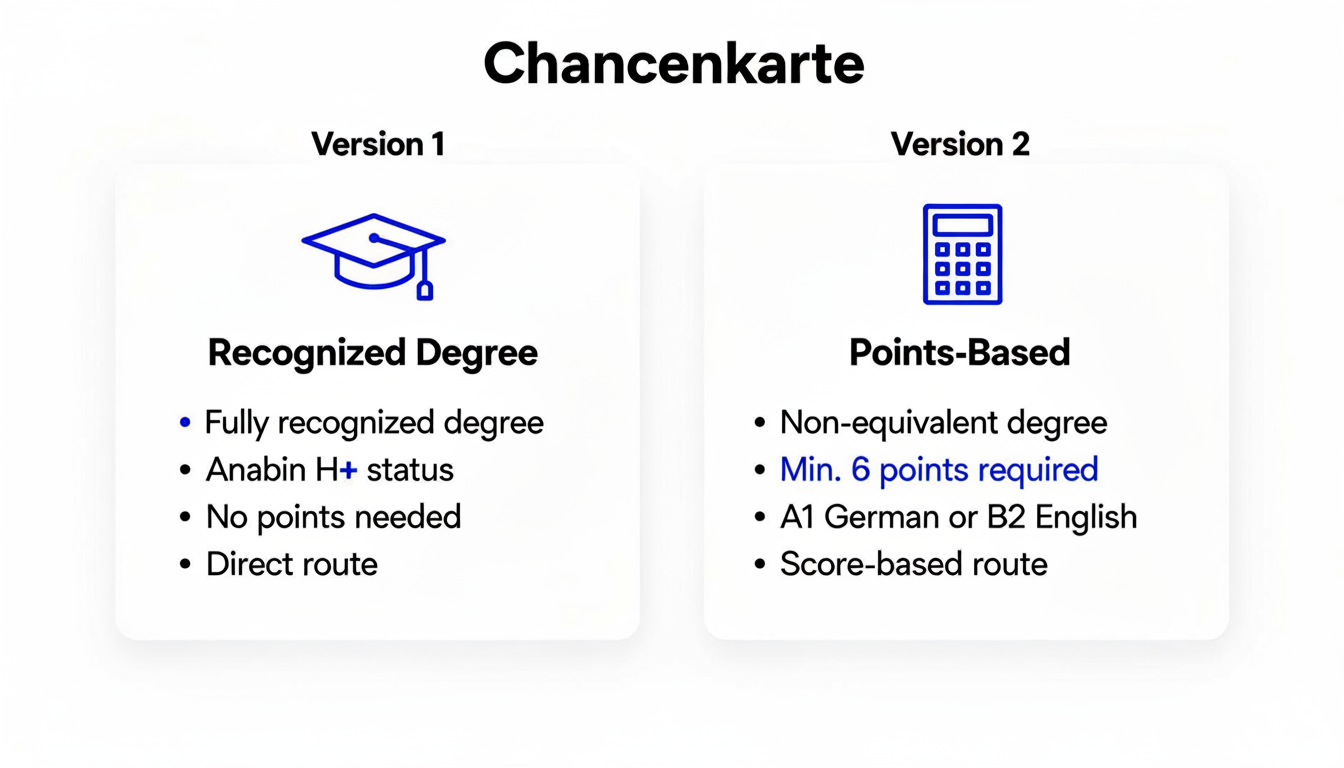
Two versions of the German Opportunity Card
Deep Dive into the 6-Point Scoring System
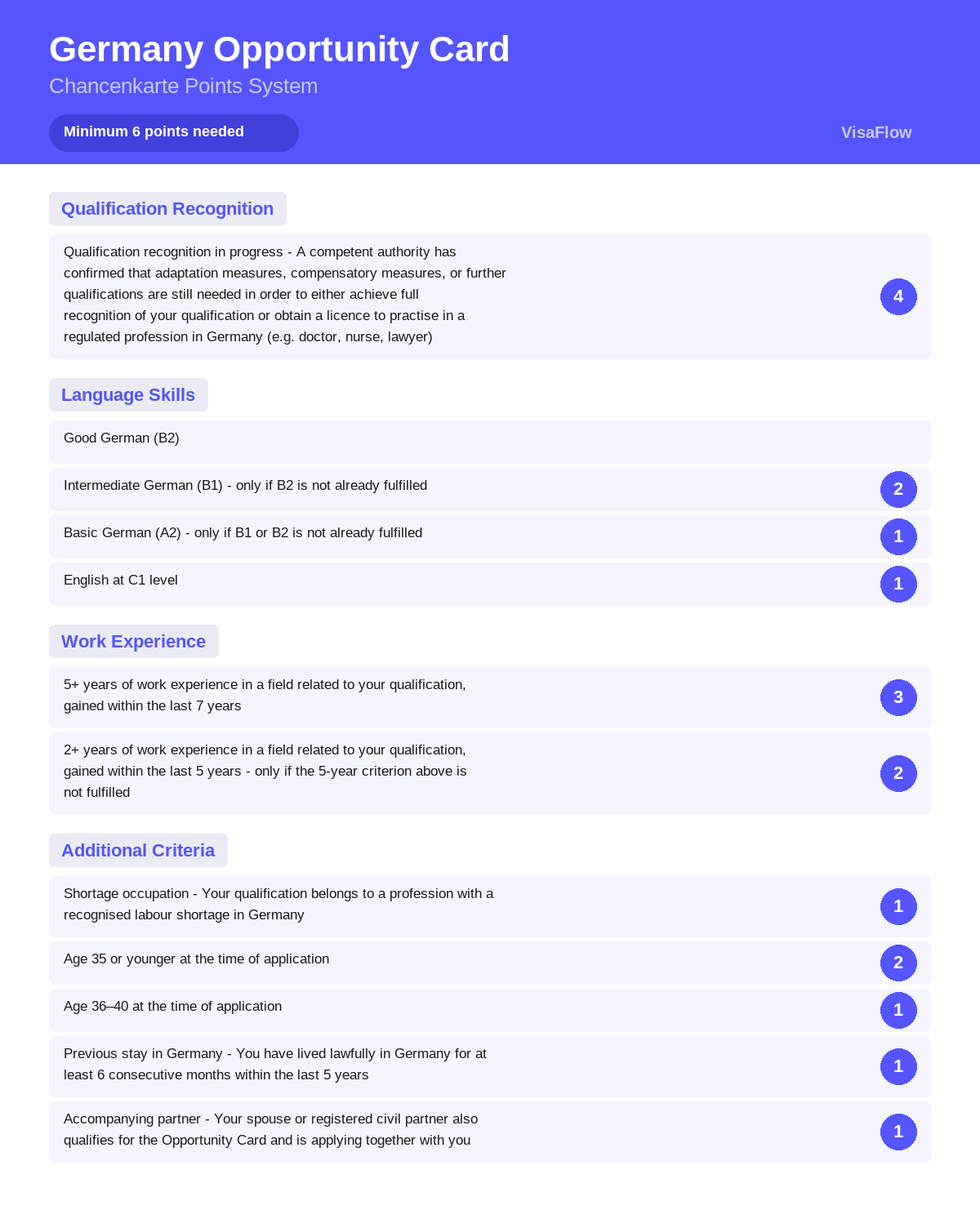
The points system is designed to reward candidates who are most likely to integrate quickly and contribute to the German economy. Here is the detailed breakdown of how those points are awarded in 2026.
- Points for Recognition and Experience The highest single point award is four points, given to those who have "partial recognition" of their foreign professional qualification. This means a German authority has reviewed your credentials and determined that you only need a small amount of additional training to meet German standards. Professional experience is also heavily weighted. If you can prove five years of experience in your field within the last seven years, you earn three points. If you have two years of experience within the last five years, you earn two points. This experience must be relevant to the qualification you hold.
- Points for Language Proficiency Language is the key to the German job market. If you have reached the B2 level in German, you are awarded three points. If you are at the B1 level, you receive two points. Even if you aren't fluent in German, having C1 level English or higher will grant you one point. At VisaFlow, we always recommend aiming for at least B1 German to maximize your chances and your employability.
- Points for Age and Connection to Germany Germany is looking for longevity in its workforce. If you are under 35 years old, you receive 2 points. If you are between 35 and 40, you receive 1 point. Applicants over 40 do not receive points for age, meaning they must make up the difference through experience or language skills.
Furthermore, if you have lived in Germany previously for at least six consecutive months (excluding tourist visits), you earn one point. This "previous stay" point recognizes that you already have some level of cultural familiarity with the country. Finally, a "Shortage Occupation" point is awarded if your profession is in high demand, such as IT, engineering, or medicine.
Here is a complete overview of all criteria and their respective point values at a glance:
Financial Requirements: The Blocked Account and Sustainability
You cannot obtain an Opportunity Card without proving you can support yourself. The German government sets a strict monthly requirement for "subsistence." For 2026, this amount is roughly €1,091 per month, totaling €13,092 for the full year.
Most applicants fulfill this through a Blocked Account (Sperrkonto). You deposit the full amount into a German bank, which then releases the monthly allowance back to you once you arrive. Alternatively, if you have already secured a part-time job offer in Germany that meets this income threshold (working 20 hours a week), this contract can serve as your proof of funds. At VisaFlow, we help you calculate exactly how much you need based on whether you have a job offer or are relying solely on savings.
The Visa Application Process: A Step-by-Step Breakdown
Applying for the Chancenkarte as a visa is a multi-step process that requires precision. One error in your points calculation or a missing document can lead to an immediate rejection.
Step 1: The Initial Assessment before doing anything else, you must determine if you are heading for the Direct Route or the Points Route. This involves a thorough Anabin check and an audit of your work experience.
Step 2: Language Certification You must have official certificates. For German, this means a Goethe-Zertifikat or TestDaF. For English, an IELTS or TOEFL is required. "Medium of Instruction" letters from your university are often not enough for the Chancenkarte; the embassy usually requires a standardized test score.
Step 3: Document Legalization Depending on your nationality your degrees and transcripts must often be apostilled or legalized by the German embassy in your home country. This confirms the documents are authentic.
Step 4: The Motivation Letter This is a critical, yet often overlooked, part of the application. You must explain your job search strategy. Which cities will you target? Which companies are you interviewing with? What is your backup plan? A strong motivation letter can be the difference between a visa approval and a request for more information.
Step 5: Health Insurance Standard travel insurance is not enough. You need "Incoming Insurance" that meets the specific requirements of the German residence act. This insurance must cover you from the day you land until you find a job and join the public healthcare system.
Working on the Opportunity Card: Rules and Restrictions
Once you arrive in Germany, the Chancenkarte gives you significant freedom, but there are rules you must follow. You are primarily here to find a "qualified" job, meaning a job that requires a degree or vocational training.
While you search, you can work 20 hours a week. This "side job" does not have to be related to your degree. You can work in retail, hospitality, or delivery services to help pay your bills. The "trial work" rule is also vital: you can work for a potential employer for up to 14 days for free or for pay to prove your skills. If the employer likes you, they can then offer you a full-time contract, at which point VisaFlow can help you transition your Opportunity Card into a Blue Card (EU) or a standard Skilled Worker Visa.
The Opportunity Card for International Students in Germany
If you're already studying in Germany, the Chancenkarte works a little differently for you - and honestly, you're in a stronger position than most applicants. You already have roots here. The question isn't whether Germany is a good fit; it's which path makes the most sense given where you are in your studies.
Below, we cover the three scenarios where the Opportunity Card becomes relevant for international students: those who've left their programme early, those waiting on final graduation documents, and those deciding between the Chancenkarte and the standard 18-month job seeker visa.
1. Students Who Have Discontinued Their Studies
Sometimes, a Master’s or Bachelor’s program in Germany isn't the right fit. If you decide to quit your studies but you already hold a bachelor’s or master’s degree from your home country, you are not necessarily forced to leave. If that previous degree is recognized via Anabin, you can switch your residency from a Student Visa to a Chancenkarte. This allows you to stay in the country legally and transition into the workforce using your existing skills.
2. Students Awaiting Graduation Documents
German university administration can be slow. It is common for students to finish their last exam or defend their thesis and then wait months for the actual degree certificate to be printed. If your student visa is about to expire during this "waiting period," the Chancenkarte is your solution. You can apply using a previous bachelor's or master's degree obtained abroad, provided it is state-recognised in the country where it was awarded.This ensures you don't have to leave Germany while waiting for your paperwork.
3. Choosing Between the 18-Month Job Seeker Visa and the Chancenkarte
For those who successfully graduate from a German university, you have a choice. You can apply for the 18-month Job Seeker Residence Permit (under Section 20 of the Residence Act) or the 12-month Chancenkarte.
We recommend the 18-month permit for German graduates. Why? Because the 18-month permit allows you to work unrestricted full-time hours in any job while you search. The Chancenkarte, by contrast, limits your secondary work to 20 hours per week. However, the Chancenkarte might be the better choice if you have already used your 18-month permit and need a one-year extension to continue your search, or if you specifically want to utilize the "trial work" provisions of the new law.
Final Summary of the Chancenkarte Benefits
The Chancenkarte is Germany's answer to one of the most frustrating problems in international hiring: you can't get a job without being there, and you can't be there without a job. The Opportunity Card breaks that deadlock by giving you up to 12 months on the ground to search, meet employers in person, and secure the contract that opens the door to long-term residency.
Here's what you need to remember. There are two ways to qualify: the Direct Route, for those with a degree that is fully recognised in Germany (Anabin H+ status), and the Points-Based Route, for those whose degree is not directly equivalent but who can score at least 6 points across five criteria - qualification level, language skills, professional experience, age, and previous time in Germany. You don't need a job offer for either route.
While you search, you can work up to 20 hours per week in any job, and you can do unlimited 2-week trial work periods with potential employers, a provision that makes the Chancenkarte uniquely practical compared to other visa types. To support yourself financially, you'll need to show proof of at least €13,092 in a blocked account, or an equivalent commitment, at the time of application.
The application itself runs through five steps: verifying your degree recognition, obtaining official language certificates, getting your documents apostilled or legalised, writing a strong motivation letter, and arranging incoming health insurance. The consulate or embassy in your home country handles the application before entry.
For international students already in Germany, the Chancenkarte is especially flexible. You can switch to it locally if you've discontinued your studies with a prior recognised degree, or if you've finished your exams and are simply waiting for your final diploma. If you graduated from a German university, it's worth comparing the Chancenkarte against the 18-month Job Seeker Visa (§ 20 AufenthG), which offers unrestricted working hours and may be the better fit depending on your situation.
Once you land a qualified job offer, the Chancenkarte converts cleanly into a Skilled Worker Visa or EU Blue Card, without requiring you to leave Germany. That continuity of legal status is one of its most underrated advantages.
Germany is actively looking for skilled professionals to fill the gaps in its labour market. The Chancenkarte is the clearest signal yet that the door is open. The question now is whether your application is ready to walk through it.
Why Choose VisaFlow for Your Chancenkarte Journey?
The German immigration system is designed to be efficient, but it is also rigid. Small mistakes lead to long delays. At VisaFlow, we specialize in ensuring your application is "bulletproof" before it ever reaches the desk of a visa officer.
We provide expert guidance on:
- Points Optimization: Making sure you claim every single point you are entitled to.
- Anabin and ZAB Navigation: Handling the complex equivalence checks so you don't have to.
- Transitioning Permits: Moving you from a Student Visa to a Chancenkarte, or from a Chancenkarte to a Blue Card, with zero gaps in your legal residency.
- Financial Planning: Assisting with the setup of blocked accounts and health insurance.
The Chancenkarte is your best chance to enter the German job market in 2026. Whether you are applying from abroad or are already in Germany as a student, the Opportunity Card provides the flexibility and legal security you need to succeed.


Frequently Asked Questions
Can I bring my family to Germany on an Opportunity Card?
Yes, family reunification is possible under the Chancenkarte. To bring your spouse or children, you must prove you have a larger apartment (adequate living space) and additional financial means for each family member. Most embassies require a separate blocked account or a higher monthly balance (approx. €1,091 per adult) to ensure your family does not rely on German public funds.
Can I apply for the Opportunity Card if I am already in Germany as a student?
Absolutely. The Chancenkarte is a vital safety net for international students. If you have finished your exams but are waiting for your physical degree to be issued, or if you have discontinued your current studies but hold a previous recognized degree, you can switch to the Opportunity Card locally at your Ausländerbehörde (Foreigners' Office).
How much money do I need in my Blocked Account for 2026?
For a 12-month stay, you must prove at least €13,092 (approximately €1,091 per month). This can be shown through a blocked account, a formal declaration of commitment (Verpflichtungserklärung), or a part-time job contract in Germany that covers these costs.
Can I use my student blocked account for the Opportunity Card?
Yes, but you will likely need to "top it up". While the 2026 student monthly rate is €992, the Opportunity Card requires €1,091. You must update your account to reflect the higher monthly release amount to satisfy the Ausländerbehörde.
Is an Anabin check mandatory for the Opportunity Card?
Yes, for the "Direct Route," your university must have an H+ status and your degree must be listed as Equivalent in the Anabin database. If your degree is not listed, you must apply for a Statement of Comparability from the ZAB (Central Office for Foreign Education) before submitting your application.
What is the minimum points score required for the Chancenkarte?
You need a minimum of 6 points to qualify via the points-based route. Points are awarded for partial recognition of your degree (4 points), professional experience (2–3 points), language skills (1–3 points), age under 40 (1–2 points), and previous stays in Germany (1 point). If your degree is already fully recognized (Anabin H+), you qualify for the "Direct Route" and do not need to calculate points.
Is the 18-month Job Seeker Visa better than the Chancenkarte for graduates?
For graduates of German universities, the 18-month Job Seeker Visa (§ 20 AufenthG) is usually superior. It offers 6 months more than the Chancenkarte and grants unrestricted work rights, meaning you can work full-time in any job while searching. The Chancenkarte is better if you have already exhausted your 18-month permit or if you graduated from a university outside of Germany.
Can I convert my Opportunity Card into a Blue Card?
Yes. As soon as you find a job that meets the salary threshold and matches your qualifications, you can apply to convert your Chancenkarte into an EU Blue Card or a Skilled Worker Residence Permit without leaving Germany. At VisaFlow, we specialize in managing this transition to ensure you can start your new job on time.
How do I prove a previous six-month stay in Germany for points?
To earn the 1 point for a previous stay, you must have lived in Germany legally for at least six consecutive months within the last five years. Proof includes previous registration certificates (Meldebescheinigung), rental contracts, old residence permits, or university enrollment records. Tourist trips do not count.
Can I work immediately upon arrival with the Opportunity Card?
Yes. You are permitted to work 20 hours per week in any sector immediately. Additionally, you can engage in unlimited two-week trial employment periods with prospective employers to test the fit before committing to a full-time role.