.png)

Master’s in Germany: How to Find English-Taught Programs at Public Universities (2026)
.webp)
Master’s in Germany: How to Find English-Taught Programs at Public Universities (2026)
Written by Isma Khalid
Are you dreaming of advancing your career with a Master’s degree from a world-class institution without the burden of massive tuition fees? Germany is calling.
As the land of ideas, Germany has become a top destination for international students, offering high-quality education, a vibrant culture, and, most importantly, thousands of programs taught entirely in English.
We know that the first step, actually finding the right course, can feel overwhelming. That’s why we’ve created this definitive guide to help you navigate the official German database like a pro and secure your spot at a tuition-free public university.
Why Choose a Public University in Germany?
Before we dive into the "how," let’s talk about the "why."
- No Tuition Fees: Most public universities in Germany charge zero tuition fees for both EU and non-EU students (you only pay a small semester contribution of roughly €150–€400).
- Global Recognition: German degrees are respected by employers worldwide.
- Post-Study Work Visa: You are eligible for an 18-month job-seeker visa after graduation.
Exception: Public universities with Tuition Fees in Germany:
While most public universities in Germany offer tuition-free education, some federal states have introduced specific fees for international students from non-EU/EEA countries. As of 2026, here is where you can expect to pay more than just the standard semester contribution:
- Baden-Württemberg: This is currently the only state with a mandatory, state-wide tuition fee for non-EU students. You will be charged €1,500 per semester at all public universities in cities like Stuttgart, Heidelberg, Freiburg, and Karlsruhe.
- Bavaria: Recent legislative changes now allow individual public universities in Bavaria to decide whether to charge international fees. For example, the Technical University of Munich (TUM) now charges non-EU students between €1,500 and €6,000 per semester, depending on the program. However, other Bavarian schools, like LMU Munich, currently remain tuition-free, charging only the standard semester fee.
The DAAD International Programmes Database
While Google is great, it’s cluttered. To find accredited, English-taught Master’s degrees, you need to use the DAAD (German Academic Exchange Service) database. This is the official gold standard for international students.
Step-by-Step Guide: How to Find Your Master’s Program
Follow these steps to filter through thousands of options and find the perfect match at a public university.
Step 1: Access the Database
Go to the DAAD International Programmes Search Engine.
Step 2: Set Your Basic Filters
On the main search bar), apply these initial filters:
- Course Type: Select "Master’s degree".
- Course Language: Select "English". (Ensure you check this so you aren't required to provide German proficiency like TestDaF or DSH).
Once you click the “search” button, you will see all the masters programs offered in Germany.

Choosing the main search filters on the website
Step 3: Filter for Public Universities
On this page, you will see more filters on the left. To avoid private institutions that charge high fees, look for the "Institution Type" filter and select:
- University (Universitāt - focus on research/theory)
- University of Applied Sciences (Fachhochschule - focus on practical/professional application)
Must select “Fully on–site” option in “Mode of study” options as enrolling for a hybrid program is one of the leading reasons for German study visa rejection.
Step 4: Refine by Subject and Location
Use the "Field of Study" filter to narrow down your interest (e.g., Engineering, Business, Social Sciences). If you have a specific city in mind, like Munich, Berlin, or Hamburg, enter it in the "City" field.
Step 5: Check the "Tuition Fees" Filter
To be 100% sure, scroll down to the "Tuition Fees" section and select "None" or “up to 500 EUR per semester” or more depending on your budget.
Note: In some states, public universities charge non-EU students €1,500 per semester. If your budget is strictly €0, you may want to exclude this region.
%20(1).webp)
Choosing search filters on DAAD website
Pro-Tips for Using the DAAD Website
- The "Save" Icon: You can create a shortlist by clicking the save icon on programs you like. This allows you to compare modules, deadlines, and requirements later.
- Check the "Requirements" Tab: Each program listing has a tab for "Requirements/Registration." Pay close attention to the GPA requirements and whether they require an IELTS/TOEFL score.
- Check the Deadline: German universities usually have two intakes: Winter (starts October) and Summer (starts April). Deadlines for Winter often fall around July 15th, but for international students, they can be as early as March!
Stay Organized with the VisaFlow Shortlist Template
Finding the program is only half the battle. To keep track of deadlines, specific entry requirements, and module details, you need a system.
Download our Custom Shortlist Template directly or make a copy on Google Sheets!
Using this template ensures you don't miss a single detail that could make or break your application.
Understanding the "How": Application Procedures & Language Proof
Once you have your list of universities, the next hurdle is understanding how to apply and what language proof you need. Not all universities follow the same path.
Before you hit "Submit," make sure to read our guides on:
- The Three Application Procedures: We break down the differences between three application procedures at German universities: Uni-Assist, Direct Applications, and the VPD (Vorprüfungsdokumentation) process.
- Proof of Language: Learn about proof of language accepted at German universities.
Then comes the student visa process. This is where things get technical.
Mastering the Student Visa Process
Once you secure your admission letter, VisaFlow is here to hold your hand through every single step that follows. From securing your student visa to obtaining your post-graduation work permits, we handle everything involved in setting you up in Germany.
Get in touch with your university's international office, they are likely one of our 60+ global partners. If they are, you get access to the VisaFlow platform for free.
VisaFlow decodes the entire German bureaucracy for you, acting as your smart, personal action plan. We ensure your transition to Germany is seamless, organized, and successful.
Don’t navigate the complex German system alone. Let VisaFlow be there for you when bureaucracy feels overwhelming!
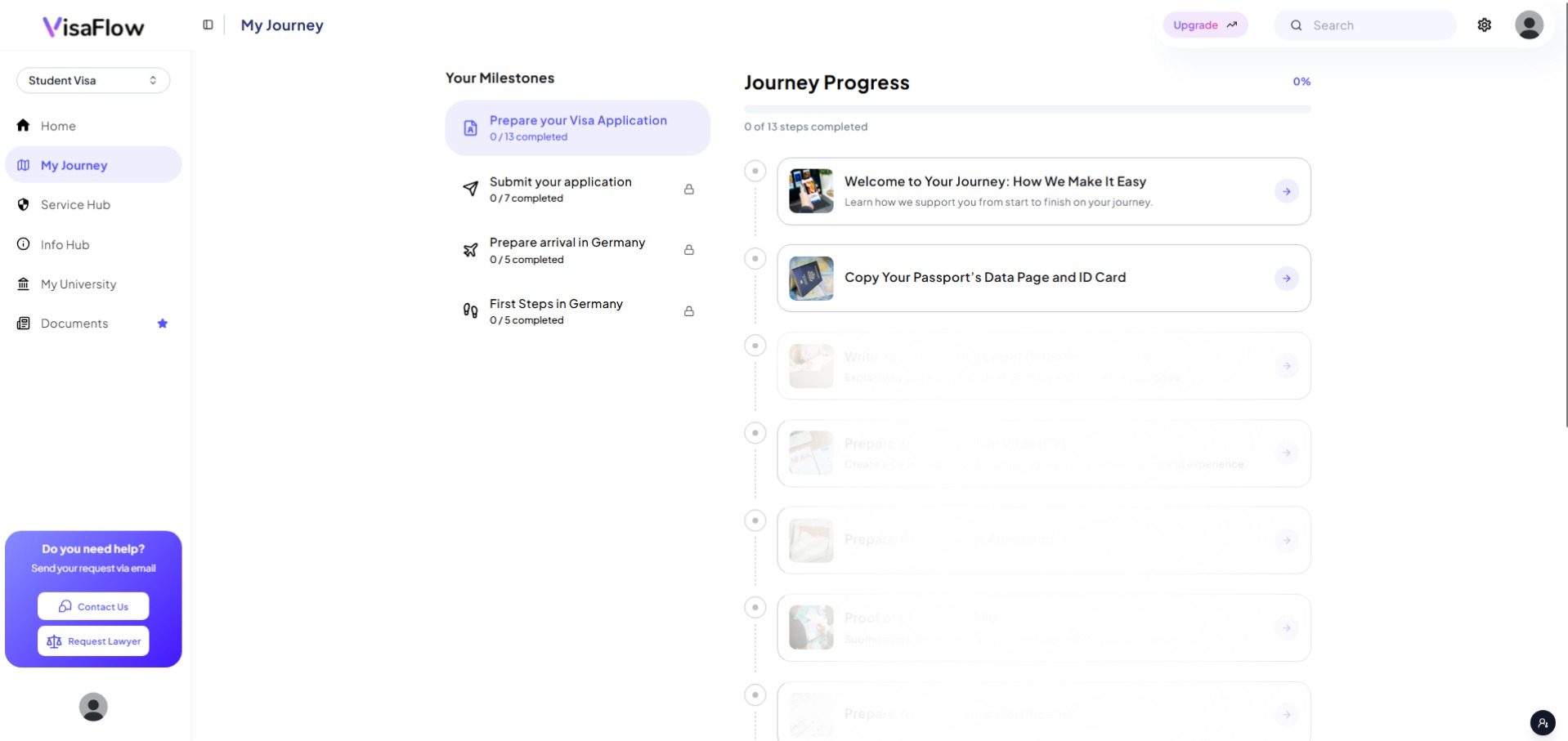
An overview of student visa personal action plan
Can I really study in Germany for free if I don't speak German?
Yes! Most public universities in Germany offer English-taught Master’s programs with no tuition fees for international students. You only need to pay a small "Semester Contribution" (approx. €150–€400) which usually includes a public transport ticket.
What is the difference between Uni-Assist and a Direct Application?
Uni-Assist is a centralized service that evaluates international certificates for many German universities for a fee. A Direct Application means you apply through the university’s own online portal. Some universities also require a VPD (preliminary review documentation) from Uni-Assist before you apply to them directly.
Do I need an IELTS/TOEFL score, or is a Medium of Instruction letter enough?
It depends on the university. Many high-ranking programs require a formal English test (IELTS/TOEFL). However, some universities accept a Medium of Instruction (MOI) letter if your entire Bachelor’s degree was taught in English.

.webp)
.webp)
