.png)

How to Apply to German Universities 2026: Direct, uni-assist & VPD Guide
%20(1).webp)
How to Apply to German Universities 2026: Direct, uni-assist & VPD Guide
Written by Isma Khalid
Navigating the German university landscape is a thrilling but complex journey. With world-class education, low tuition fees, and a vibrant culture, it’s no wonder Germany is a top destination for international students. However, the first hurdle isn't the exams, it’s the application process.
We know that getting your admission letter is just the beginning. To help you cross that first finish line, we’ve broken down the three primary ways to apply to German universities: Direct Application, uni-assist, and the VPD (Preliminary Review Documentation) route.
1. The Direct Application
Many German universities, particularly some of the larger technical universities (TU) and specialized colleges, allow students to apply directly through their own online portals (like TUMonline or SIM).
How it Works
In this scenario, you bypass third-party intermediaries. You create an account on the university’s official website, upload your digital documents, and wait for their internal admissions office to evaluate your qualifications.
Why Choose Direct Application?
- Faster Decisions: Since there is no "middleman," the university can often process your application more quickly.
- Cost-Effective: Many direct applications are free, saving you the fees typically associated with service providers.
- Direct Communication: You are in constant contact with the university's International Office, making it easier to track your specific status.
Pro Tip: Always check if your specific course allows direct application, as many universities use a mix of direct and uni-assist methods depending on the program.
2. Application via uni-assist
uni-assist is a service used by roughly 170 German universities to pre-screen international applications. Think of it as a centralized clearing house that ensures your documents meet German academic standards before they reach the university's desk.
The uni-assist Process
- Register: Create a "My assist" account.
- Evaluate: You upload your school leaving certificates and university transcripts.
- Grade Conversion: uni-assist converts your home country’s grades into the German grading system.
- Forwarding: Once they confirm you meet the criteria, they forward your application to the universities you’ve selected for a final decision.
Key Benefits
- Apply to Multiple Schools: You only need to upload your documents once to apply to dozens of partner universities.
- Standardization: It ensures your grades are evaluated fairly according to the "Anabin" database standards.
Understanding the Costs (2026 Fees)
Applying via uni-assist involves a processing fee that must be paid before they begin evaluating your documents:
- First Application: €75 for your first chosen course of study in an application semester.
- Additional Applications: €30 for each additional course or university you apply to within the same semester.
3. The VPD (Preliminary Review Documentation) Route
The VPD (Vorprüfungsdokumentation) is a unique hybrid process. Some universities want uni-assist to verify your documents but want to handle the actual admission themselves.
What is a VPD?
The VPD is a formal document issued by uni-assist that confirms your eligibility to study in Germany and lists your converted German grade.
How to get a VPD and Apply:
- Apply for VPD via uni-assist: You submit your documents to uni-assist specifically requesting a "Preliminary Review Documentation".
- Wait for Processing: This usually takes 4 to 6 weeks, so plan early!
- Direct Submission: Once you receive the VPD (usually as a PDF in your My assist inbox), you must then apply directly to the university through their own portal, uploading the VPD as a required document.
Note: A VPD is not an admission letter. It is simply a "green light" that tells the university your documents are valid and what will be your grade as per the German grading system. You must still submit a separate application to the university before their deadline.
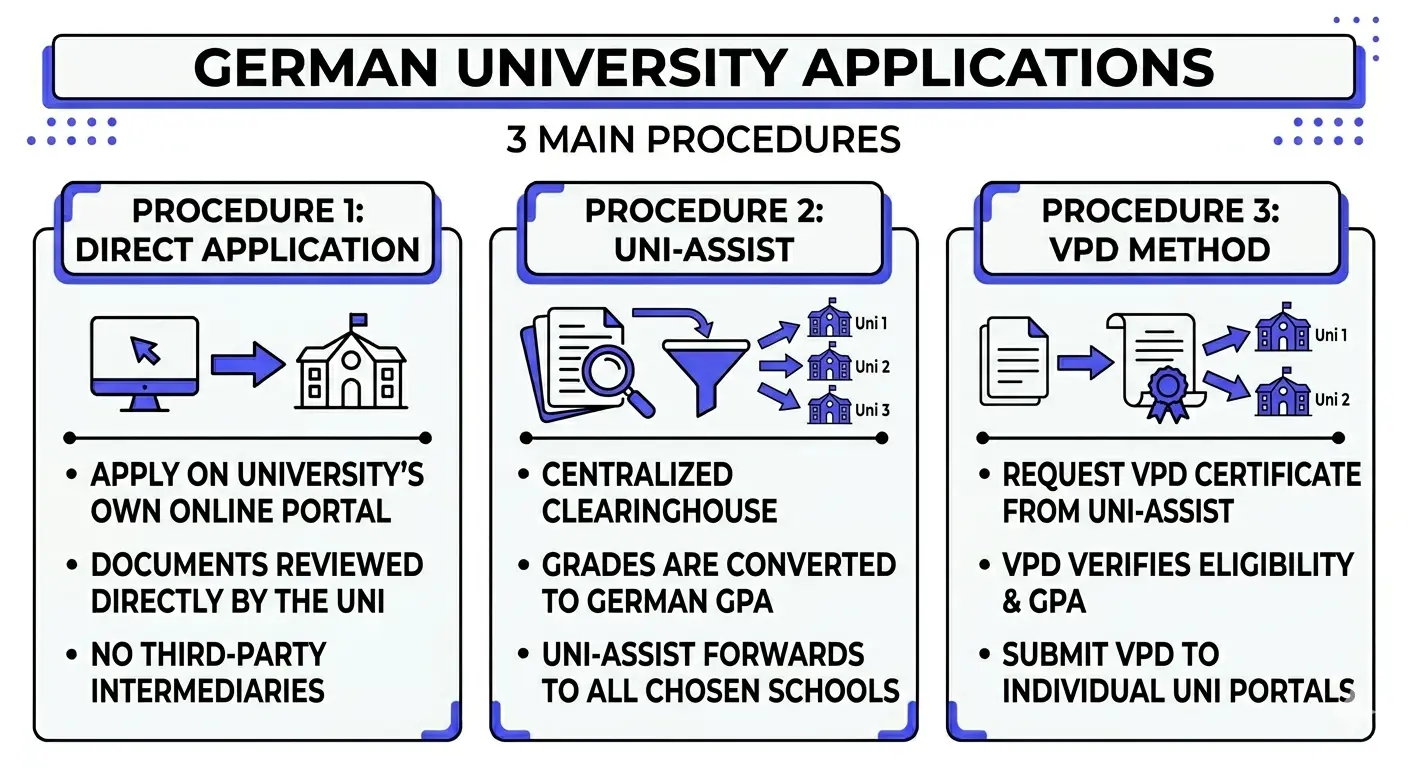
Three application procedures at German universities
Steps after Admission
Receiving that "Zulassungsbescheid" (Admission Letter) is a massive achievement, but it’s only half the battle. Next comes the most daunting part: The German Student Visa.
Between blocked accounts, health insurance, and embassy appointments, the bureaucracy can feel overwhelming. That is where VisaFlow steps in.
How VisaFlow Supports You
Once you have your admission letter, VisaFlow has your back. We provide a comprehensive digital platform designed to simplify the visa journey, your initial months in Germany, and even beyond.
- Your Personal Action Plan: Know exactly what to do next - tailored to your nationality and visa type.
- A Motivation Letter That Works: Your Statement of Purpose drafted or refined by experts, so your application tells a clear, convincing story.
- The Right Blocked Account & Insurance: Compare providers in real-time and choose the option that fits your situation.
- Verified Information, Not Forum Rumors: Every requirement confirmed and up to date - so you never have to rely on outdated advice.
Your visa is step one. VisaFlow stays with you through your residence permit, post-grad applications, and everything in between.
Ready to start? Your Germany journey begins here.
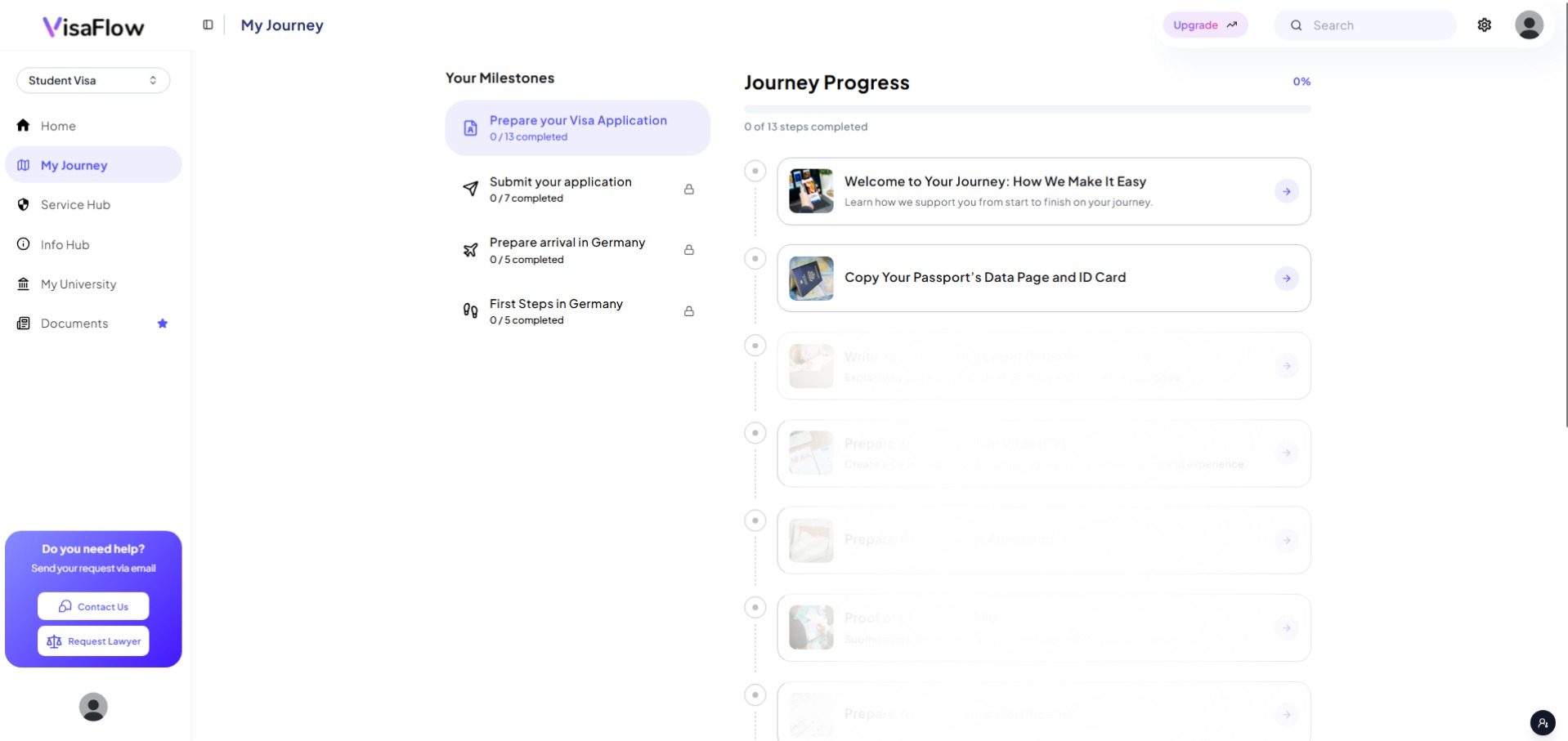
An overview of personal action plan for visa process
Exclusive Access for Partner Schools
Are you applying to one of our 60+ partner universities? If so, we have great news! Students from our partner schools get completely free access to the VisaFlow platform.
Don't leave your future to chance. Once you have that admission letter in hand, ask your university international office for free access code and let VisaFlow handle the heavy lifting of the German bureaucracy so you can focus on what matters: your studies and your new life in Germany.
How much does it cost to apply via uni-assist in 2026?
Applying through uni-assist involves a processing fee of 75€ for your first university choice in a given semester. If you wish to apply to additional universities or courses within the same semester, each extra application costs 30€. These fees cover the evaluation of your international certificates and the conversion of your grades into the German system.
Should I upload separate motivation letters for each university on uni-assist?
Yes, absolutely. While uni-assist allows you to upload general documents, most universities expect a tailored Letter of Motivation that addresses their specific program and faculty. To ensure the right letter goes to the right school, you should clearly rename your files before uploading them (e.g., Motivation_Letter_TUM_Name.pdf or Motivation_Letter_LMU_Name.pdf). When you assign documents to a specific application in the "My assist" portal, having distinct names prevents confusion and demonstrates to the admissions committee that you are genuinely interested in their specific curriculum. While for other documents like academic certificates, uni-assits recommends to upload each document once only, even when applying to multiple universities.
What is a VPD and can I use the same one for all universities?
A VPD (Vorprüfungsdokumentation) is a preliminary review document issued by uni-assist that confirms your eligibility to study in Germany and lists your converted German GPA. Generally, you cannot use the same VPD for all universities; you typically need to request a separate VPD for each specific institution you apply to, as the document is often issued specifically for that school. While in some rare cases certain universities might accept a VPD issued for another institution, it is standard practice to order a dedicated one for each application to avoid rejection.


.webp)