.png)
The Complete Guide to EU Blue Card vs. Skilled Worker Permit Germany

Landing a job offer in Germany is a monumental achievement, but for non-EU citizens, it is only the first step. The real challenge begins with the German immigration system. In 2026, the landscape for international talent has shifted significantly following the full implementation of the latest Skilled Immigration Act reforms.
For university graduates and experienced professionals, two pathways dominate the conversation: the EU Blue Card (Section 18g) and the Skilled Worker Residence Permit (Section 18b). While both grant you the right to live and work in Europe's largest economy, choosing the wrong one can delay your permanent residency by years or complicate your family’s relocation.
Quick Facts: Germany EU Blue Card 2026
- Standard Salary Threshold: €50,700 gross/year (€4,225/month)
- Reduced Threshold (Graduates & Shortage Occupations): €45,934.20 gross/year (€3,827.85/month)
- Graduate Rule: Applies to anyone who graduated within the last 3 years.
- Shortage Occupations: IT, Engineering, Math, Natural Sciences, Medicine, and Health/Education.
- Occupation must match qualification: The job offered must be relevant to the applicant’s university degree or recognized qualification
- Permanent Residency Options after: 21 months (with B1 German) or 27 months (with A1 German).
- Fallback Option: Skilled Worker Residence Permit (§ 18b) if salary is below thresholds.
1. The EU Blue Card: The "Gold Standard" for Academics
The EU Blue Card (Section 18g AufenthG) is a premium residence permit designed for highly qualified non-EU citizens. It is specifically built to fast-track your path to permanent residency and provide maximum mobility within the European Union.
2026 Salary Thresholds & Variations
The German government adjusts salary thresholds annually based on the pension insurance ceiling. For 2026, the thresholds are categorized as follows:
- Standard Occupations: You require an annual gross salary of at least €50,700 (approximately €4,225 per month).
- Shortage Occupations (MINT/Health): For roles in mathematics, IT, natural sciences, engineering, and medicine, a lower threshold of €45,934.20 (approximately €3,827.85 per month) applies.
- Recent Graduates: If you obtained your degree within the last three years, you also qualify for the lower threshold of €45,934.20, regardless of your field of study.
The Expanded Shortage Occupation List
In 2026, the list of shortage occupations has grown. It no longer just covers "MINT" (Mathematics, IT, Natural Sciences, and Technology). The current list includes:
- Manufacturing, mining, construction, and distribution managers.
- Information and communication technology service managers.
- Professional services managers (childcare, health, and aged care).
- Veterinarians, dentists, and pharmacists.
- Nursing and midwifery professionals.
- Teaching and educational professionals.
The "New Entrant" Advantage for Graduates
A common misconception is that young graduates must meet the high "Standard" threshold. This is false.
If you have obtained your university degree within the last three years (regardless of whether it was in Germany or abroad), you qualify as a "career starter." In 2026, this allows you to obtain an EU Blue Card with the lower threshold of €45,934.20, even if your job is not in a shortage occupation like IT or Engineering.
2. The Skilled Worker Residence Permit: The Essential Fallback
If your salary does not meet the Blue Card's €45,934.20 or €50,700 marks, you aren't out of luck. The Skilled Worker Residence Permit for Graduates (Section 18b AufenthG) serves as the primary fallback option.
When should you choose Section 18b?
- Lower Salary: Your job is "qualified" (requires a degree), but the pay is below the Blue Card minimum.
- Over 45 Years Old: If you are over 45 and entering Germany for the first time, you typically need a salary of at least €55,770 (2026) or proof of adequate old-age pension. If you don't meet this for a Blue Card, Section 18b is your path.
- Degree-Job Match: While the Blue Card requires the job to be "appropriate" to the degree, the Skilled Worker permit is slightly more flexible, provided the job requires a university-level qualification.
The 45-Year-Old Rule
A unique quirk of German law in 2026 concerns older professionals. If you are over 45 years old and moving to Germany for the first time, you must earn at least €55,770 per year (or prove you have an equivalent private pension plan). If you earn less than this, even if you meet Blue Card requirements, the authorities may insist on the Skilled Worker Permit (§ 18b) to ensure you aren't a future burden on the social system.
3. Comparison: EU Blue Card vs. Skilled Worker Permit
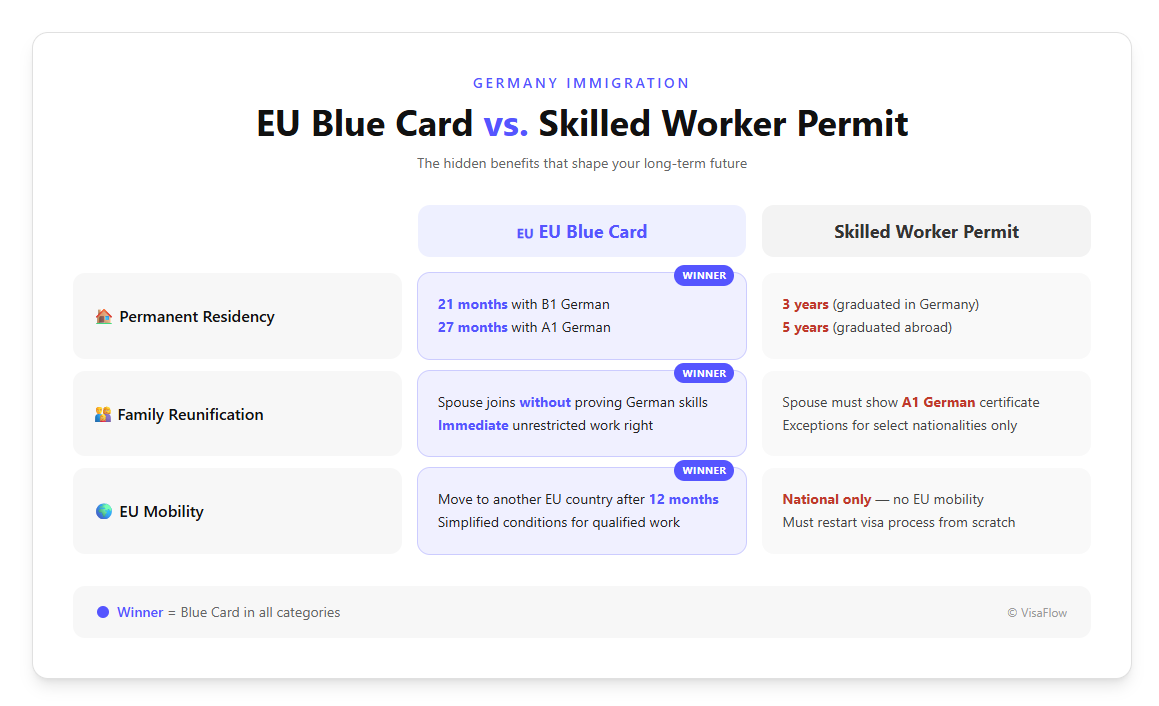
While both permits allow you to work and live in Germany, the "hidden" benefits make a massive difference in your long-term future.
Permanent Residency (Settlement Permit)
This is where the Blue Card truly shines.
- EU Blue Card: You can apply for permanent residency after just 21 months (if you have B1 German) or 27 months (if you have A1 German).
- Skilled Worker Permit: Generally, you must wait 3 years (if you graduated in Germany) or 5 years (if you graduated abroad) to apply for a settlement permit.
Family Reunification
- EU Blue Card: Your spouse can join you without needing to prove any German language skills. They also receive an unrestricted right to work immediately.
- Skilled Worker Permit: Generally, spouses must provide a certificate showing basic (A1) German skills before arriving. There are exceptions (e.g., if you are from certain countries like the USA, Canada, or Australia), but for most, this is a major hurdle.
EU Mobility
- EU Blue Card: After 12 months, you can move to another EU country for highly qualified work under simplified conditions.
- Skilled Worker Permit: This permit is national. To move to another EU country, you would generally have to start a new visa process from scratch in that country
4. Pros and Cons at a Glance
EU Blue Card
Pros:
- Fastest path to permanent residency (under 2 years).
- Easier family reunification (no language test for spouse).
- Ability to stay outside the EU for up to 12 months without losing the permit.
- Standardized mobility across most of Europe.
Cons:
- Strict salary thresholds that increase every year.
- Requires a recognized university degree (though IT specialists can now apply with 3 years of experience).
Skilled Worker Residence Permit (§ 18b)
Pros:
- No fixed minimum salary (as long as it matches local market standards/collective agreements).
- Accessible to more junior roles or lower-paying sectors.
- Valid for up to 4 years (or the length of the contract).
Cons:
- Slower path to permanent residency.
- Stricter requirements for family members (language).
- No automatic mobility to other EU states.
5. Which One Is Right For You?
The decision usually comes down to your gross annual salary and your long-term goals.
- If you earn over €50,700: Always go for the EU Blue Card. The administrative benefits and the speed of getting permanent residency are worth it.
- If you are a recent graduate earning ~€46,000: Go for the EU Blue Card. You qualify for the lower threshold, and it jumpstarts your residency clock.
- If you earn €40,000: The Skilled Worker Permit is your only viable option. It still provides a secure legal status and a path to staying in Germany indefinitely, it just takes a bit longer.
6. Strategic Advice for 2026 Graduates
If you are a recent graduate, the EU Blue Card is almost always the superior choice. Because you qualify for the reduced threshold (€45,934.20) for the first three years after graduation, you should aim for this even if your employer offers you a Section 18b permit by default.
Why? Because life happens. If you decide to move to another EU country in two years, the Blue Card makes that possible. If your spouse wants to join you, the lack of an A1 certificate requirement saves months of time and thousands of Euros in language school fees.
How VisaFlow Simplifies Your Application
Navigating the 2026 updates for EU Blue Card or Skilled Worker Residence Permit shouldn't be a full-time job. Whether you're calculating if your bonus counts toward the threshold or checking if your degree is "appropriate" for your job title, VisaFlow automates the complexity.
Our platform provides:
- The Journey Manager: Think of this as your personal mission control. It provides a tailored, step-by-step guide that tracks your progress in real-time. It tells you exactly what to do next!
- The Info Hub: Stop scrolling through confusing forums. Our Info Hub is a curated library of expert-verified resources. It has authentic answers for all your possible questions, so you can avoid hours of research and misinformation.
- The Service Hub: Through our Service Hub, you can instantly compare and secure the best Blocked Account providers, and find the right Health Insurance packages. You can also find information on platforms for housing search, network providers and language schools.
- Expert Support: Inside the platform, you can submit your documents for professional review and ask for expert advice in case of any confusion.
Ready to start your journey? Let VisaFlow handle the bureaucracy so you can focus on your future in Germany.


Frequently Asked Questions
What is the EU Blue Card salary threshold for 2026?
As of January 1, 2026, the standard gross annual salary threshold for the EU Blue Card in Germany is €50,700. For shortage occupations (such as IT, Engineering, and Healthcare) and for recent university graduates, a reduced threshold of €45,934.20 applies.
What is the difference between Section 18g and Section 18b?
Section 18g (EU Blue Card) is for high-earning academics and offers the fastest path to permanent residency (21–27 months). Section 18b (Skilled Worker Permit) is the fallback option for those who earn less than the Blue Card threshold but hold a recognized degree; it typically requires 3 to 5 years for permanent residency.
How long does it take to get Permanent Residency (Settlement Permit)?
With an EU Blue Card, you can obtain a settlement permit in 21 months if you have B1 German skills, or 27 months with basic A1 German. Under a Skilled Worker Permit, the timeline is usually 3 years for German university graduates or 5 years for those with foreign degrees.
What happens if I lose my job while on a Blue Card?
If your employment ends, you must notify your local Ausländerbehörde (Immigration Office) immediately. You are usually granted a period of 3 to 6 months to find a new qualified position that meets the Blue Card requirements.
Can I get an EU Blue Card as a fresh graduate?
Yes. If you have graduated from a university within the last 3 years, you qualify for the EU Blue Card under the lower salary threshold of €45,934.20 (2026). This "Career Starter" rule applies regardless of whether your job is on the official shortage occupation list.
Which professions are considered "Shortage Occupations" in 2026?
Germany has expanded the list of bottleneck professions. In addition to IT specialists, engineers, mathematicians, and doctors, the list now includes: Manufacturing, construction, and distribution managers Veterinarians, dentists, and pharmacists Nursing and midwifery professionals School and out-of-school teachers and educators
Can my spouse work in Germany if I have an EU Blue Card?
Yes. Spouses of EU Blue Card holders have immediate and unrestricted access to the German labor market. Unlike other visa types, they generally do not need to prove German language proficiency (A1) before joining you in Germany.