.png)
The Complete Guide to finding a PhD Position in Germany

Are you looking to elevate your academic career in one of the world’s leading research hubs? Germany is consistently ranked as a top destination for international researchers, offering world-class facilities, no tuition fees, and a high standard of living. However, the path to a doctorate in Germany is unique and can be confusing for those used to the US or UK systems.
In this comprehensive guide, we will break down everything you need to know about finding a PhD position in Germany. Whether you are looking for a structured PhD program or an individual doctoral position, we provide a step-by-step roadmap to navigate the application process, secure funding, and handle your visa requirements with ease.
Germany PhD 2026: Fast Facts for Researchers
Germany is the world’s leading hub for tuition-free doctoral research. A significant portion of STEM PhD positions are funded as professional employment contracts, offering full social security and competitive salaries.
- Tuition Fees: €0 (Zero tuition at all public universities for all nationalities).
- Average PhD Salary (TV-L E13): Most researchers earn between €2,100 and €3,100 Net monthly, depending on the field (typically 65% to 100% contracts).
- Blocked Account (2026): €992 per month (€11,904/year) is the minimum required for visa applicants who do not have an employment contract.
- Program Duration: Usually 3 to 5 years, with no fixed start dates for individual doctorates.
- Language: English is the primary research language in STEM; German (C1) is typically only required for Humanities or Law.
- Visa Advantage: PhD holders are eligible for a 18-month Job Seeker Visa immediately upon graduation.
- Semester Fee: A small administrative contribution of €200–€400 per semester, which usually includes a free public transport pass for the entire region.
1. Why Pursue a Doctorate in Germany?
Germany isn’t just about beer and cars; it’s a global powerhouse for innovation. In 2026, the German government continues to invest heavily in R&D, making it an ideal environment for a research position.
The Research Powerhouse of Europe
Germany spends over 3% of its GDP on research and development, outperforming most of its European neighbors. For a PhD candidate, this translates to state-of-the-art laboratories, extensive library archives, and a massive network of industrial partners like Siemens, Bosch, and Bayer. Unlike other nations where higher education is a product, Germany treats doctoral research as a public good, ensuring that doctorate in Germany remains accessible to global talent.
The German Difference
Unlike the US or UK, where you often apply to a centralized "Graduate School" for a 5-6 year program that includes coursework, the German system is primarily research-focused
- No Tuition Fees: At public universities, you don't pay for your PhD.
- Early Independence: You are treated more like a professional colleague than a student.
- Funding: Most PhD candidates are actually employees of the university (more on this below).
2. How the PhD System in Germany Works: A Deep Dive
Before you send a single email, you must understand that "Doing a PhD" in Germany can mean two very different things. Your search strategy depends entirely on which path you choose.
Individual Doctorate (Individualpromotion)
This is the traditional "German Way." Over 70% of doctoral candidates in Germany follow this path. In this model, you find a professor (your Doktorvater or Doktormutter) who agrees to supervise your research.
- Flexibility: There are no set start dates. You can begin your research any time of the year.
- The Hunt: You are responsible for finding your own supervisor and, often, your own funding.
- Independence: You work primarily one-on-one with your supervisor. There are rarely mandatory classes, allowing for a deep focus on your specific research position.
Structured PhD Programs (Strukturierte Promotion)
These programs are similar to the international "Graduate School" model. They are often organized by Research Training Groups (Graduiertenkollegs) funded by the DFG (German Research Foundation).
- Interdisciplinary: You are part of a cohort of students working on related topics.
- Supervision: Instead of one professor, you usually have a "Thesis Advisory Committee" (TAC).
- Language: These programs are almost exclusively in English.
- Fixed Deadlines: Unlike the individual model, these have strict application windows (usually once or twice a year).
Employment vs. Scholarship: The Financial Reality
One of the most confusing aspects for international students is how they are "paid." In 2026, the distinction is sharper than ever:
- Scientific Staff (Wissenschaftlicher Mitarbeiter): You sign a formal employment contract with the university. You have an office, teaching duties, and full health insurance. You are a professional researcher.
- Scholarship Holders (Stipendiaten): You receive a monthly grant (e.g., from the DAAD). You are technically a "student," not an employee. You must pay for your own health insurance (Public or Private).
3. Requirements for a PhD in Germany
Before you start searching for a PhD position in Germany, ensure you meet these core criteria:
- Academic Degree: You must hold a Master’s degree (or equivalent) that is recognized in Germany.
- GPA/Grades: Generally, an "Above Average" grade is required (usually 2.5 or better on the German scale).
- Anabin Recognition: Check the Anabin database to see if your foreign degree is equivalent to a German one. This is a critical step for your researcher visa later.
- Language Proficiency:
- English: Most STEM and Social Science PhDs are in English. (IELTS 6.5+ or TOEFL 90+).
- German: Only necessary if you are in specific humanities fields or if your project requires local archives/fieldwork.
- Publications: Not mandatory, but having one or two peer-reviewed papers significantly boosts your chances for competitive doctoral positions.
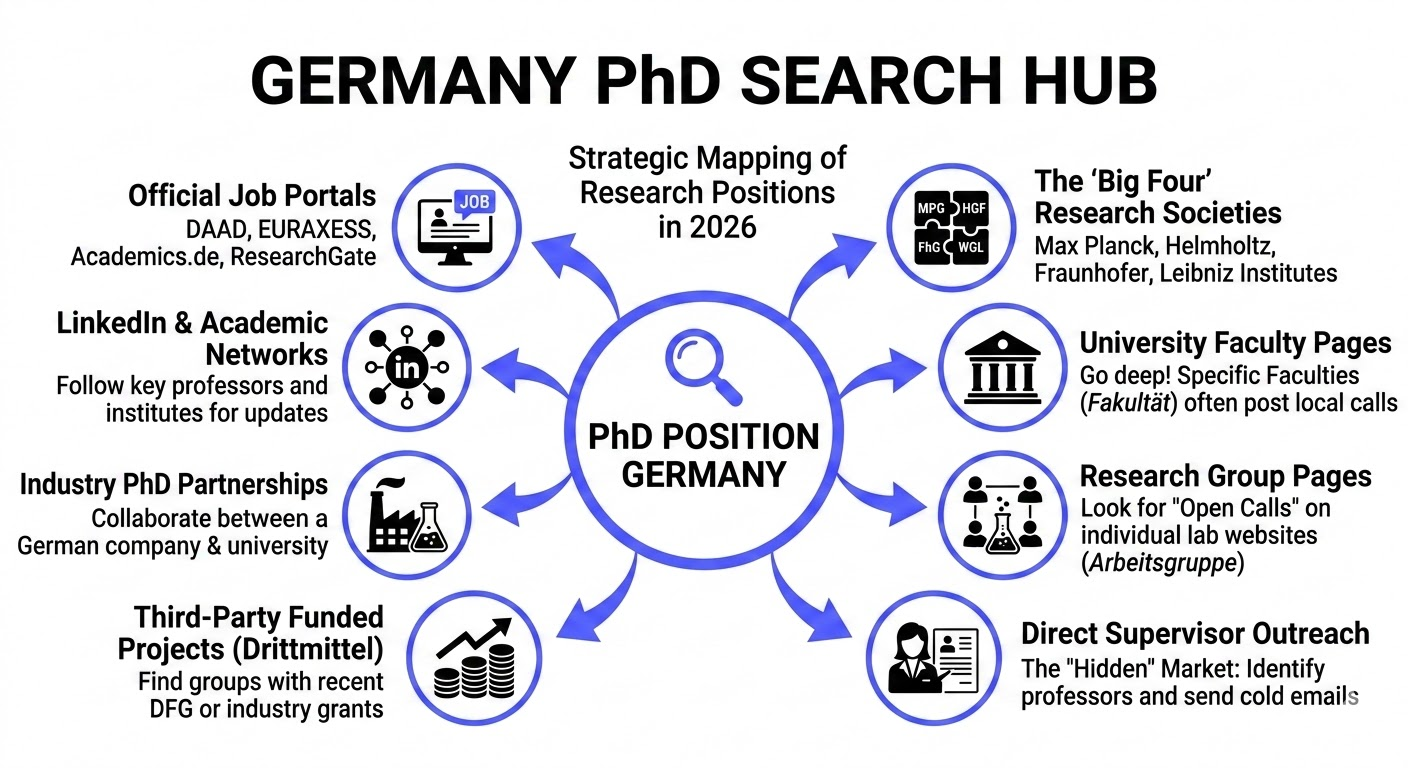
4. Where to Find PhD Positions in Germany
This is the core of your search. Do not limit yourself to just one platform.
A) Official Job Portals
- DAAD (German Academic Exchange Service): The holy grail for international students. Their "International Programmes" database is excellent.
- EURAXESS Germany: A massive portal for mobile researchers.
- Academic.de : A specialized job board for European academia.
- ResearchGate Jobs: Excellent for niche scientific roles.
- LinkedIn/Indeed: Use keywords like "Wissenschaftlicher Mitarbeiter" or "PhD Position Germany".
B) University & Research Institute Websites
Don't just look at universities (TU9 or U15 groups). Germany has world-famous non-university research institutes that offer prestigious PhD positions:
C) Direct Supervisor Outreach (The "Hidden" Market)
Many doctoral positions are never advertised. They are "created" because a professor likes a candidate's proposal.
- Identify: Use Hochschulkompass to find professors in your niche.
- Evaluate: Read their few latest publications to identify their areas of research that could possibly align with your interests.
- Outreach: Send a "Cold Email" with a professional CV and a 1-2 page research abstract.
5. Step-by-Step: The Application Process
Applying for a doctorate in Germany is a marathon of paperwork. Here is how to navigate it in 2026.
Phase 1: The Research Topic
You need a "Research Proposal". This is a 5–10 page document that outlines:
- Your Research Question.
- The State of the Art (what is already known).
- Your Methodology (how you will prove your hypothesis).
- A Timeline (a 3-year plan).
Phase 2: Finding a Supervisor (Doktorvater/Doktormutter)
In the individual model, you need a "Letter of Acceptance" from a professor before you can even enroll at the university. Send your CV and a 2-page abstract of your proposal.
Phase 3: Preparing the Academic CV
A German academic CV is different from a US resume.
- Include: Your Master’s thesis title and supervisor.
- Research Interests: Be very specific.
- Publications: List even "under review" papers.
- Technical Skills: Programming languages, lab techniques, or archival experience.
Phase 4: The Interview and Negotiation
If the professor likes your profile, they will invite you for an interview (usually via Zoom/Teams). Be prepared to discuss:
- Why their specific lab?
- How will you fund your stay? (Do they have a position, or must you apply for a scholarship?)
- Your long-term career goals in Germany.
6. Funding and Salaries: What is TV-L E13?
In Germany, most PhD candidates are employees. You will likely be paid according to the TV-L E13 scale. This stands for Tarifvertrag für den öffentlichen Dienst der Länder (Collective Agreement for the Public Service of the States).
Understanding the Percentages
Because a PhD involves both "work for the university" (teaching/admin) and "work for yourself" (writing your thesis), positions are rarely 100%.
- 50% Position: You work 20 hours for the professor; the rest is for your thesis. Common in Social Sciences. Net pay: €1,400 – €1,600.
- 65% Position: The standard for most STEM fields. Net pay: €1,800 – €2,100.
- 100% Position: Common in high-demand fields like AI, Robotics, and Engineering. Net pay: €2,500 – €2,950.
Scholarships (Stipends)
If you don't get a contract, you can apply for a scholarship.
- DAAD: The most common. Usually €1,350/month.
- Political Foundations: Organizations like the Konrad-Adenauer-Stiftung or Friedrich-Ebert-Stiftung provide funding for students with high social engagement.
7. Visa and Residence Permit Basics
For non-EU researchers, the visa process is the final hurdle. In 2026, Germany has made this easier through the Skilled Immigration Act.
Which Visa Do You Need?
- The Student Visa (§16b): Best for scholarship holders. Allows you to work 140 full days per year on the side.
- The Researcher Visa (§18d): Best for those with a TV-L contract. This visa is a "work permit" and makes it much easier to bring a spouse or children with you.
- The EU Blue Card: If your PhD contract pays more than a certain threshold (approx. €40,000 - €45,000 depending on the field), you may qualify for a Blue Card, the fastest path to permanent residency.
The Residence Permit (Aufenthaltstitel)
Once you arrive in Germany, you must visit the Ausländerbehörde (Foreigners' Office) to convert your entry visa into a residence permit. You will need:
- Proof of health insurance (Public or Private).
- A rental contract (Wohnungsgeberbestätigung).
- Your University Enrollment or Employment Contract.
VisaFlow Tip: Always ensure your passport is valid for at least 6 months beyond your planned stay. German authorities are very strict about passport expiration dates.
8. Timeline: A Realistic Expectation
Finding and starting a doctorate in Germany is a multi-stage process that usually takes between 5 and 11 months in total:
- Months 1–3: Researching programs, shortlisting supervisors, and drafting your research proposal.
- Months 4–5: Submitting applications and engaging in cold-email outreach to professors.
- Months 6–7: Attending interviews and receiving a formal selection or offer letter.
- Months 8–11: Finalizing your employment contract and processing your visa or residence permit.
9. Ready to Start Your Research Journey?
Finding a PhD position in Germany is a marathon, not a sprint. The rewards, high-quality research, a stable salary, and excellent career prospects, are well worth the effort.
How VisaFlow can help:
We provide more than just general advice; we offer the tools you need to secure your researcher visa and settle in Germany with confidence:
- Step-by-Step Guides: Our interactive roadmaps guide you through every milestone, from your first contact with a supervisor to your appointment at the Ausländerbehörde (Foreigners' Office).
- Up-to-Date Checklists: Never miss a document. We provide live-updated checklists tailored to your specific situation, whether you are on a TV-L E13 contract or a DAAD scholarship.
- Bureaucracy Info Hub: Stop wasting hours on forums. Our curated info hub answers all your questions about health insurance, the "Anmeldung" process, and tax IDs, ensuring you avoid the common pitfalls of misinformation.
- Service Hub: Compare and secure the best plans for your Blocked Account, private or public health insurance in one place.
- Expert Support & Review: Our experts are standing by to help you stand out. We offer professional drafting and review services for your Letter of Motivation and CV, ensuring they meet the specific expectations of German professors and research societies.
Ready to start your research journey without the paperwork headache?
Explore the VisaFlow platform to get started


Frequently Asked Questions
Is a PhD in Germany paid?
Yes, most STEM and many Social Science positions are paid via a work contract (TV-L E13). If not, students apply for scholarships (DAAD, Heinrich Böll, etc.).
Is a PhD in Germany free?
There are no tuition fees at public universities. You only pay a "Semester Contribution" (approx. €200–€400), which usually includes a public transport ticket.
Can I do a PhD in Germany in English?
Absolutely. Most structured PhD programs and research-heavy fields use English as the working language.
Can I apply without publications?
Yes, especially for entry-level PhD positions. However, a strong Master’s thesis is essential.