.png)
The Complete Guide to EU Blue Card for Researchers

The EU Blue Card for Researchers and Postdocs is the premier immigration pathway for high-level academics looking to build a career in Europe. If you are an international scientist, a PhD holder, or a postdoctoral fellow, this residence permit offers a streamlined route to some of the world’s most prestigious research institutions and a fast track to permanent residency.
At VisaFlow, we specialize in simplifying the complexities of European immigration. This comprehensive guide explores everything you need to know about the 2026 EU Blue Card requirements, its specific benefits for the academic community, and how it compares to the standard Research Visa.
2026 EU Blue Card Factsheet for Researchers & Postdocs
- Standard Annual Salary Threshold: €50,700 gross.
- Reduced STEM & Shortage Threshold: €45,934.20 gross (covers most research and postdoc roles).
- Career Starter Provision: €45,934.20 gross if you graduated within the last 3 years.
- Minimum Contract Duration: Just 6 months required.
- Fast-Track Permanent Residency: Eligible in 21 months (with B1 German) or 27 months (with A1 German).
- Family Benefits: Spouses relocate without German language certificates and have full work rights.
- Right to Choose: If you have a "Hosting Agreement" and meet the salary threshold, you can choose the Blue Card over the Research Visa for faster residency.
What is the EU Blue Card for Researchers?
The EU Blue Card is a merit-based work and residence permit designed to attract highly qualified non-EU citizens. While it is often associated with corporate executives and IT specialists, it is an exceptionally powerful tool for researchers and postdocs who hold a recognized university degree and have secured a qualifying employment contract in an EU member state.
Unlike a standard work permit, the Blue Card is governed by EU-wide directives (specifically Directive 2021/1883), which ensure harmonized standards across the participating countries. For a postdoc, this means your expertise is recognized as a "high-value" asset, granting you privileges that other visa categories simply cannot match.
When is there a Right to Choose between the EU Blue Card and Researcher Visa?
In the specialized world of German immigration law, many postdocs and PhD candidates find themselves in a "dual eligibility" scenario. If your academic position is backed by a formal hosting agreement from a recognized research institution (qualifying you for the Section 18d Research Visa) and your gross annual salary also exceeds the 2026 Blue Card threshold (currently €45,934.20 for STEM fields), you have the legal right to choose which residence permit is issued.
This choice is a powerful tool for career planning. While a university HR department might default to the Research Visa because it aligns with academic funding structures, you are not obligated to accept it if you meet the Blue Card criteria. Choosing the EU Blue Card (§18g) is generally the strategic move for researchers aiming for long-term integration, as it offers the fastest possible track to permanent settlement. Conversely, if your project involves extensive mobility within the EU for more than six months or if your funding is a mix of stipends and salary, the Section 18d Research Visa may offer the necessary flexibility. At VisaFlow, we recommend evaluating your three-year career goals before your appointment to ensure you select the permit that best supports your trajectory toward European residency.
Why Postdocs Choose the Blue Card Over a Research Visa
Many academics are often presented with two choices: the Research Visa (Directive 2016/801) or the EU Blue Card. While the Research Visa is excellent for those on fellowships or hosting agreements, the EU Blue Card is superior for those with traditional employment contracts. The primary draw? Speed to permanent residency. In Germany, for example, a Blue Card holder can obtain a settlement permit in as little as 21 months, whereas a standard research permit often requires several years of continuous residence.
Eligibility Criteria for Researchers in 2026
To qualify for an EU Blue Card as a researcher or postdoc, you must meet three core pillars of eligibility. The 2026 updates have made these thresholds more accessible, particularly for those in "bottleneck" academic disciplines.
1. Higher Education Qualifications
You must hold a completed university degree. For postdocs, this is typically your PhD (Doctorate), but a Master’s degree is also sufficient if the job role requires that level of expertise.
- Recognition: Your degree must be recognized in the country where you intend to work. In Germany, this is verified through the Anabin database or a ZAB Statement of Comparability.
- Relevance: The position you are taking must be commensurate with your academic background. A PhD in Molecular Biology would easily qualify for a Senior Researcher role in a biotech firm or university.
2. The Employment Contract
You must have a binding job offer or a signed employment contract with a duration of at least six months. This is a significant improvement from previous years where a one-year minimum was often required.
- Position Type: For postdocs, the contract must be for an academic or research-oriented role. This includes positions at public universities, private research institutes, and R&D departments in the private sector.
3. Salary Thresholds for 2026
Salary is the most critical factor for Blue Card eligibility. The thresholds are updated annually based on national income statistics.
- Standard Occupations: For 2026, the general gross annual salary threshold in Germany is €50,700.
- Shortage Occupations (MINT/STEM): Most researchers fall into "shortage occupations", including mathematicians, natural scientists, engineers, and medical doctors. For these roles, the reduced threshold for 2026 is €45,934.20.
- Career Starters: If you obtained your degree within the last three years (which applies to many fresh PhD graduates), you may also qualify for the lower salary threshold of €45,934.20, regardless of whether your field is officially listed as a shortage occupation.
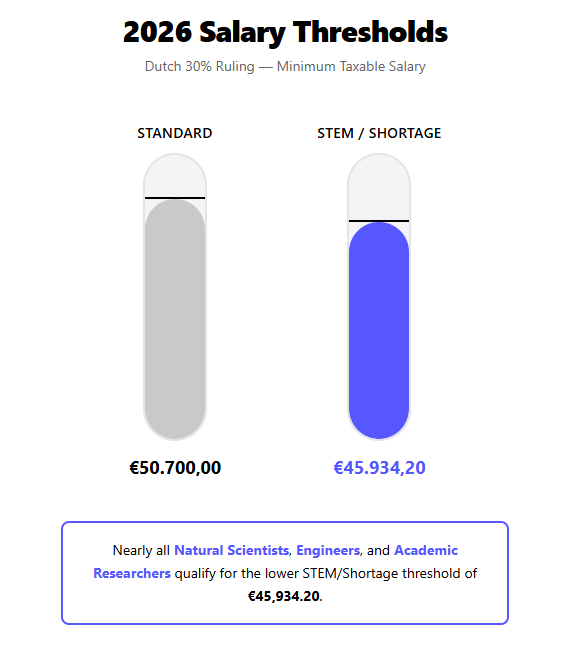
Blue Card for Researchers 2026 Salary Thresholds
Key Benefits for the Academic Community
The EU Blue Card isn't just a visa; it’s an elite status that provides researchers with stability and freedom to focus on their scientific contributions.
Fast-Track to Permanent Residency
The biggest advantage for postdocs is the accelerated timeline for a Settlement Permit (Niederlassungserlaubnis).
- After 27 Months: You can apply for permanent residency if you have been employed and paying social security contributions.
- After 21 Months: If you can demonstrate B1-level proficiency in the local language, the timeline is slashed to under two years.
For a researcher on a fixed-term postdoc contract, this speed is vital. It allows you to transition from "temporary visitor" to "permanent resident" before your first major grant or contract expires.
Enhanced Family Reunification
Academia is a global endeavor, and moving with a spouse or children is a common requirement. The EU Blue Card offers the most favorable family reunification rules:
- No Language Requirement: Unlike other visas, your spouse does not need to prove basic language skills (A1) before joining you.
- Unrestricted Work Rights: Your spouse is granted immediate and unrestricted access to the labor market. They can work in any field, be self-employed, or start a business.
Intra-EU Mobility
Research is collaborative. The Blue Card allows for Short-term Mobility, enabling you to work in another EU member state for up to 90 days within a 180-day period for research purposes. After 12 months of holding a Blue Card in one country, you can move to another EU country (e.g., moving from a lab in France to a lab in Germany) and apply for a new Blue Card under simplified conditions.
Comparing the Blue Card and the Section 18d Research Visa
Many universities will automatically suggest the Section 18d Research Visa because it allows for "Hosting Agreements," which are often easier for HR departments to process. However, as a postdoc, you should weigh your options carefully as the long-term benefits differ significantly.
Regarding contract requirements, the EU Blue Card (§18g) requires a standard employment contract, whereas the Research Visa can be granted based on either a contract or a specialized hosting agreement. The salary requirement is the most distinct factor: the Blue Card demands meeting specific high-income thresholds (such as the €45,934.20 limit for STEM researchers), while the Research Visa is more flexible, generally only requiring proof that you can cover your basic cost of living.
The most critical difference for your future in Europe is the Permanent Residency (PR) timeline. EU Blue Card holders enjoy an accelerated track, qualifying for a settlement permit in just 21 to 27 months. In contrast, those on a standard Research Visa typically must wait the full 48 months required under general immigration rules.
Furthermore, if your research project ends, the job search rights vary; the Blue Card generally allows for a 3-month period to find new employment, while the Research Visa specifically grants a 9-month window to seek a position commensurate with your qualifications. Fortunately, both permits are highly favorable for families, as neither requires a spouse to prove language proficiency prior to joining you in the EU.
The Application Process for Researchers
Navigating the bureaucracy of a national immigration office can be daunting. At VisaFlow, we recommend a structured approach to ensure your application is successful on the first attempt.
Step 1: Document Preparation
Gather your PhD or Master’s certificates, your signed employment contract, and proof of health insurance. If your degree is not from an EU university, you must obtain a recognition statement.
Step 2: The Visa Application (If Outside the EU)
If you are currently outside the EU, you will apply for a National Visa for the purpose of the EU Blue Card. This allows you to enter the country and begin work immediately.
Step 3: Registration and Health Insurance
Upon arrival, you must register your address at the local town hall (Bürgeramt). As a researcher, you will typically be enrolled in the public health insurance system, which is a requirement for the final residence permit. On our specialized Service Hub, you can also compare different health insurance providers to find exactly which health insurance suits your specific needs as an international researcher.
Step 4: The Residence Permit Appointment
You will visit the local immigration office (Ausländerbehörde) to exchange your entry visa for the actual EU Blue Card. This card is usually issued for the duration of your contract plus an additional three months, up to a maximum of four years.
Critical Considerations for Postdoc Contracts
Academic contracts are notorious for being complex. When reviewing your offer for Blue Card compliance, keep these factors in mind:
- Fixed-Term vs. Permanent: Most postdoc roles are fixed-term (e.g., 2 or 3 years). The Blue Card is perfectly compatible with this, provided the contract is at least 6 months long.
- Part-Time Positions: If your research position is 50% or 75% (common in some German "TV-L" pay scales), your actual gross salary must still meet the threshold. A 50% position rarely meets the Blue Card minimum unless the pay scale is exceptionally high.
- Allowances and Bonuses: In 2026, certain non-guaranteed bonuses may not count toward your threshold. Ensure your "base salary" is clearly defined in the contract.
Success Strategies for International Researchers
To maximize your chances of a smooth transition into the European research ecosystem, consider these professional tips:
- Negotiate Your Salary Scale: If your offer is just a few hundred euros below the shortage occupation threshold, inform the HR department. Many universities are willing to adjust the "Stufe" (level) of your pay scale to help you qualify for the Blue Card, as it reduces their administrative burden as well.
- Start Degree Recognition Early: Don't wait for a job offer to check your degree status. If your university is not listed in the Anabin database with an "H+" status, start the ZAB recognition process immediately, as it can take several months.
- Monitor the 18-Month Job Seekers Window: If your postdoc ends and you haven't yet reached permanent residency, remember that Blue Card holders (and researchers) have a generous window to stay in the country and find a new high-level role.
How VisaFlow Empowers Your Research Career
The path from a PhD to a settled career in Europe should be defined by your scientific breakthroughs, not your ability to navigate complex immigration forms. At VisaFlow, we provide an all-in-one guidance platform designed to take the guesswork out of your transition to the European research community.
We empower researchers and postdocs through a structured, resource-rich environment:
- Step-by-Step Application Guides: We break down the EU Blue Card process into manageable stages, ensuring you know exactly what to do from the moment you sign your contract to the day you receive your residence permit.
- Updated Compliance Checklists: Our checklists are strictly aligned with 2026 legal standards, covering every specific document required for academic and research-based applications.
- The VisaFlow Info Hub: A deep-dive repository of knowledge where you can find the answers to niche questions about academic degree recognition, family reunification, and the "Right to Choose" between permits.
- The Service Hub: A dedicated space where you can compare health insurance providers to see which plan suits your specific needs as an international researcher and access other essential relocation services.
- Expert Support: When the bureaucracy feels overwhelming, our team of experts is available to provide the professional clarity you need to move forward with confidence.
The EU Blue Card for Researchers is your ticket to a stable, prosperous academic career in Europe. By leveraging VisaFlow’s expert resources and meeting the 2026 requirements, you aren’t just securing a job, you are securing your future in the global scientific community.


Frequently Asked Questions
What is the minimum salary for an EU Blue Card for researchers in 2026?
For 2026, the gross annual salary threshold for the EU Blue Card in Germany is €50,700 for standard occupations. However, most researchers and postdocs qualify under the shortage occupation (STEM/MINT) category, which has a significantly lower threshold of €45,934.20. Additionally, if you have completed your degree within the last three years, you qualify as a "career starter" at the same reduced rate of €45,934.20, regardless of your specific field of study.
Does a postdoc fellowship (stipend) qualify for the EU Blue Card?
Generally, no. The EU Blue Card requires a formal employment contract subject to social security contributions. Many postdoc fellowships are tax-free stipends (Stipendium) rather than "TV-L" employment contracts. If you are on a fellowship, the Section 18d Research Visa is usually the appropriate pathway. However, if your fellowship is structured as an employment contract and meets the salary minimums, you may still be eligible.
Can my spouse work in Germany if I have an EU Blue Card?
Absolutely. One of the premier benefits of the Blue Card is that spouses are granted a residence permit with unrestricted access to the German labor market. They do not need to prove any German language skills before arriving, and they can work in any field, including self-employment or starting a business, without needing a separate work permit.
Can I switch from a Research Visa (§18d) to an EU Blue Card (§18g)?
Yes. If your circumstances change, for example, if you receive a salary increase that puts you above the 2026 threshold, you can apply to switch your residence title at your local Ausländerbehörde. Many researchers make this switch to take advantage of the fast-track permanent residency (settlement permit) which can be obtained in as little as 21 months under the Blue Card scheme.
What are the German language requirements for Blue Card holders?
There is no language requirement to obtain the initial EU Blue Card. However, your German proficiency determines how quickly you can stay forever. You can apply for a Settlement Permit after 21 months if you have B1 level German, or after 27 months with basic A1 level German. This is one of the fastest routes to permanent residency in the European Union.
Is my PhD from outside the EU recognized for the Blue Card?
To qualify, your degree must be recognized in Germany. You can check the Anabin database for an "H+" rating for your university. If your specific degree isn't listed, you will need to apply for a Statement of Comparability from the ZAB (Zentralstelle für ausländisches Bildungswesen). Having this document ready before your visa appointment is essential for a smooth application process.