.png)
German Student Residence Permit Guide 2026: Requirements & Steps
.jpg)
Getting your German Student Residence Permit (Aufenthaltserlaubnis zu Studienzwecken) is the final, most crucial step in your journey to study in Germany. While your entry visa gets you through the door, the residence permit is what allows you to actually live, work, and stay for the duration of your degree.
At VisaFlow, we know that dealing with German government offices (the Amt) can feel overwhelming and complicated. This comprehensive guide simplifies the German student residence permit process for 2026, breaking down the Section 16b (§ 16b AufenthG) requirements, application timelines, and essential legal terminology so you can navigate the Foreigners' Authority (Ausländerbehörde) with confidence and focus on your studies.
At a Glance: The German Student Residence Permit in 2026
Moving to Germany is just the first step. Here is the essential summary of the residency rules you must follow once you land:
- Permit Type: Student Residence Permit (Aufenthaltserlaubnis § 16b), a plastic eAT card.
- Who Needs It: All Non-EU/EEA students.
- Visa-Waiver: Must apply within 90 days of arrival.
- Visa-Holders: Must convert their entry visa before it expires.
- Financial Requirement: Proof of €992/month through blocked account, job contract, scholarship, or Letter of Commitment
- Processing Time: 4–12 weeks on average. You are legally allowed to stay while your application is being processed (via the Fiktionsbescheinigung).
- Key Components:
- The eAT Card: Your plastic biometric ID.
- The Zusatzblatt: The green paper detailing your work rights (140 full days/year).
- The PIN Letter: Your notification that the card is ready for collection or delivery.
VisaFlow Pro Tip: Once you have secured your housing and received your signed Wohnungsgeberbestätigung (Landlord Confirmation), book your Anmeldung (city registration) appointment immediately. You cannot submit your residence permit application without that registration paper, and slots fill up weeks in advance!
1. Visa vs. Residence Permit: What’s the Difference?
Many students use these terms interchangeably, but in the eyes of German law, they are very different documents.
- Student Visa (Visum): This is your entry document. You apply for this at a German Embassy or Consulate in your home country before you travel. It is usually a sticker in your passport and is typically valid for 6-12 months. Its only job is to get you into Germany legally so you can apply for your long-term stay.
- Residence Permit (Aufenthaltserlaubnis): This is your stay document. Once you are in Germany, you must "convert" your entry visa into a residence permit. This is a plastic ID card (the eAT) which is typically issued for 1 to 2 years at a time, depending on your local office and the length of your degree program. While the card itself has an expiration date, it can be extended. As long as you remain enrolled and continue to meet the financial and insurance requirements, you can extend your permit until you complete your studies.
- The Golden Rule: You enter with a Visa; you stay with a Residence Permit.

Graphic illustrating the temporary visa sticker (on the left); and the long-term residence permit card (on the right)
2. Visa Waiver vs. Entry Visa: Do You Need to Apply Before You Arrive?
Whether you need to visit an embassy before leaving home depends entirely on your nationality.
i. EU, EEA, and Swiss Citizens
Countries: All EU Member States, Iceland, Liechtenstein, Norway, and Switzerland.
- Entry: You do not need a visa to enter Germany. A valid ID card or passport is sufficient.
- Residency: You do not need to apply for a residence permit.
- Requirement: Your only legal obligation is to register your address (Anmeldung) at the local Citizens' Office (Bürgeramt) within two weeks of moving into your new home.
- Work Rights: You have full access to the German labor market without any restrictions on hours.
ii. Citizens of "Visa-Free" Nations (§ 41 AufenthV)
Countries: Andorra, Australia, Brazil, Canada, El Salvador, Honduras, Israel, Japan, Monaco, New Zealand, San Marino, South Korea, the United Kingdom (including Northern Ireland), and the USA.
- Entry: You can enter Germany for up to 90 days without a visa.
- Residency: You must apply for a student residence permit (Aufenthaltserlaubnis) at the Foreigners' Office (Ausländerbehörde) within 90 days of your arrival.
- Pro Tip: While you are legally allowed to enter without a visa, if you plan to start working (student job) immediately upon arrival, we recommend applying for a visa in your home country first. Otherwise, you cannot work until your residence permit is issued.
iii. All Other Countries (Mandatory Entry Visa)
Countries: Most other nations, including India, China, Turkey, Nigeria, Pakistan, Egypt, and many more.
- Entry: You must apply for a National Visa (Type D) for study purposes at a German Embassy or Consulate in your home country before you travel.
- Residency: After arriving in Germany, you must register your address and then visit the local Foreigners' Office to convert your entry visa into a long-term residence permit.
- Important Warning: Never enter on a "Schengen" (Type C) tourist visa. These cannot be converted into student permits. You would be required to fly back home and start the entire process over.
3. The 5 Core Documents for Your Residence Permit (2026 Checklist)
When applying for your student residence permit in Germany, you need a specific set of documents. German authorities value precision, so ensuring these five core items are perfect is the key to a smooth approval.
1. Proof of Financial Means (Finanzierungsnachweis): For 2026, you must prove you have at least €11,904 available for one year (€992 per month). Most students satisfy this through a Blocked Account, which releases a fixed monthly amount. However, the authorities also accept a formal Letter of Obligation (Verpflichtungserklärung), a scholarship certificate, or if you are already working, a valid job contract accompanied by your last three payslips.
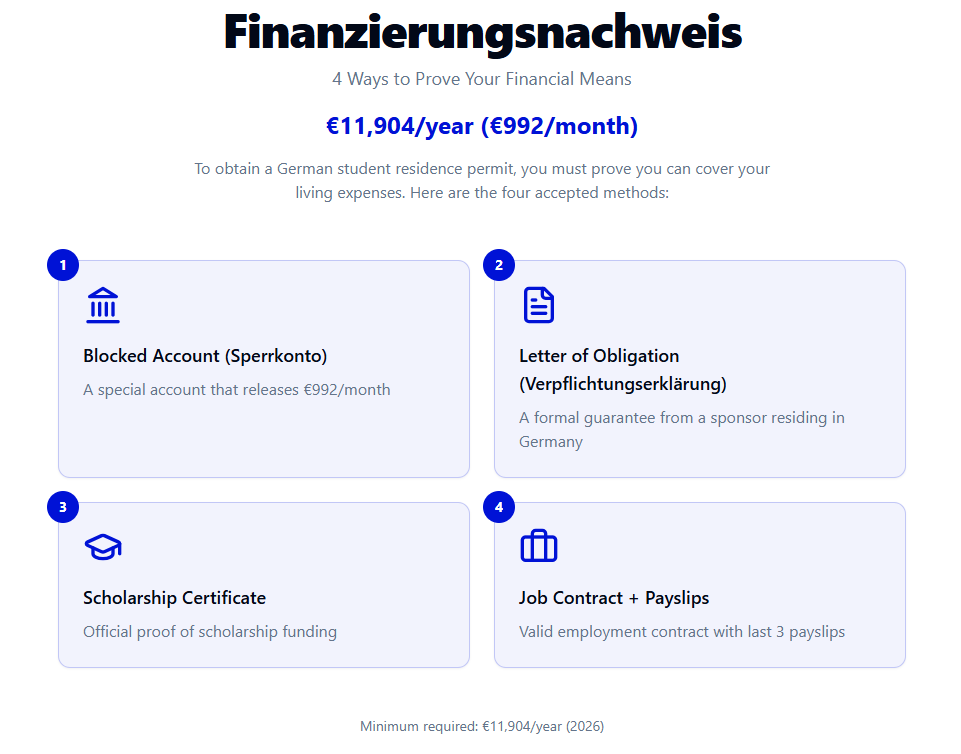
2. Certificate of Enrollment (Immatrikulationsbescheinigung): This is the official document issued by your university confirming you are a registered student for the current semester. It must clearly state your degree program and the expected duration of your studies.
3. Proof of German Health Insurance: You cannot get a residence permit without insurance that meets the strict requirements of § 16b of the Residence Act. This usually means a membership certificate from a German public provider (like TK, AOK, or Barmer). If you choose private insurance, it must specifically state that it offers unlimited coverage and includes all mandatory German benefits.Don't guess which insurance meets the legal criteria. Visit the Service Hub on our platform to compare approved public and private insurance plans and secure your coverage instantly.
4. City Registration Certificate (Meldebestätigung): Before you can apply for your permit, you must have a legal address. This certificate is the paper you receive from the Bürgeramt (Citizens' Office) after you complete your address registration (Anmeldung). You will need to bring the original document to your residence permit appointment.
5. Valid Passport & Biometric Photo: Your passport must be valid for at least six months beyond your appointment date. Along with it, you must provide a recent biometric photo (35mm x 45mm). German standards are strict: the photo must be high-resolution, taken against a neutral background, and you must have a neutral facial expression (no smiling).
While these five core documents are the foundation of every application, requirements often shift depending on the specific city and officer you encounter. Some offices may require additional residence permit forms, specific rental contract clauses, or university "Study Forecasts" to approve your stay.
Don't leave your residency to chance. Sign in to your VisaFlow account to gain full clarity on every document you will need. Our platform provides you with a personal action plan that ensures you arrive at the Ausländerbehörde with a perfectly organized folder and the confidence that nothing has been missed.
4. The Procedure: How to Apply (City by City)
The "how" depends heavily on where you live. While the laws are federal, the administration is local.
Step 1: Registration (Anmeldung)
Before you can even look at a residence permit, you must register your address at the local Bürgeramt (Citizens' Office). You need your rental contract and a signed "Wohnungsgeberbestätigung" from your landlord. Without your Meldebescheinigung (registration certificate), you effectively don't exist in the eyes of the system.
Step 2: The Application (Broad Overview)
Different cities use different systems to handle student applications:
- Online Portal: Cities like Berlin and Munich increasingly use online portals where you upload your PDFs first. They then invite you to a physical appointment.
- Email/Post: In smaller university towns, you might be asked to mail your documents or send them via email to a specific case worker.
- In-Person Appointment: You will eventually have to go in person to have your fingerprints scanned and your photo verified. To ensure a smooth approval, you must bring the physical originals of your documents to this appointment, as the officer will need to verify them in person before finalizing your residence permit
- Pro-Tip: Apply for your appointment at least 3 months before expiry of your visa, as slots in major cities like Berlin or Hamburg can be booked up months in advance.
5. Timelines: How Long Does it Take?
- Application Submission: 3 months before expiry of your visa.
- Processing Time: It typically takes 4 to 12 weeks for the office to approve your permit and for the card to be printed.
- The "Fiktionsbescheinigung": If your visa expires while you are waiting for your permit, the office will issue you a "Fictional Certificate." This paper makes your stay legal until your card is ready.
6. What is the eAT Card?
The eAT (elektronischer Aufenthaltstitel) is a credit-card-sized plastic card with a chip.
- What it contains: Your photo, fingerprints, and personal data.
- When do I get it? You don't get it on the day of your appointment. After approval, it is printed by the Federal Printing Office in Berlin and sent back to your local city office.
- Collection: You will receive a PIN letter in the mail. This means your card is ready. Depending on the city, they will either mail the card to you or ask you to book a collection appointment.
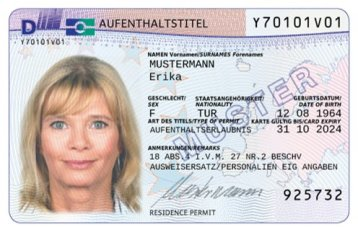
A sample of German Residence Permit (Credits: Bundesamt für Migration und Flüchtlinge)
7. What is the Zusatzblatt? (The Green Paper)
The Zusatzblatt is a supplementary green sheet of paper (or a sticker) that comes with your eAT card. Do not lose this.
While the card proves you are a resident, the Zusatzblatt contains the "fine print" of your stay:
- Work Rights: It specifies how many days you can work (usually 140 full days or 280 half days per year).
- Study Conditions: It might state that your permit is only valid for a specific university or degree program.
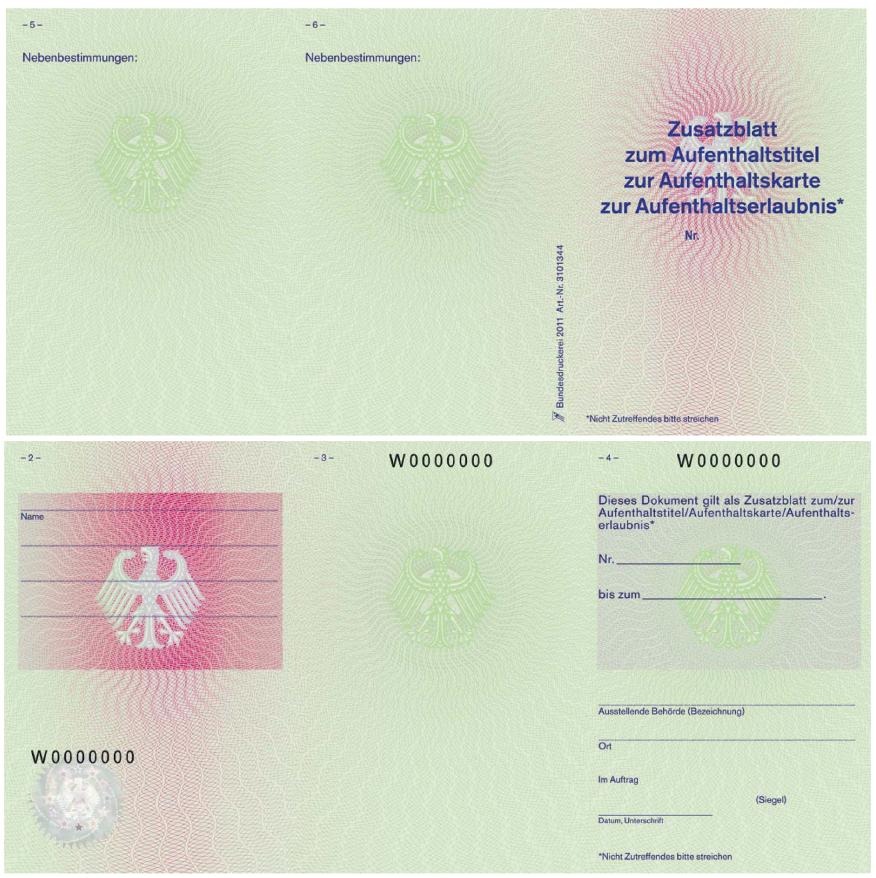
A sample of Zusatzblatt
8. University-Specific Guides
While the legal rules for a residence permit are federal, every city has its own application process. Check out our deep dives for your specific city if you are student at one of the following universities:
- Residence Permit for Technical University of Munich (TUM) Students
- Residence Permit for University of Cologne Students
- Residence Permit for Freie Universität Berlin Students
- Residence Permit for Karlsruhe Institute of Technology (KIT) Students
- Residence Permit for University of Oldenburg Students
- Residence Permit for Martin Luther University Halle-Wittenberg Students
- Residence Permit for Hochschule Bochum Students
- Residence Permit for Hochschule Aalen Students
- Residence Permit for University of Göttingen Students
- Residence Permit for OTH Regensburg Students
- Residence Permit for Hochschule Darmstadt Students
Need help with your Student Residence Permit Application?
German bureaucracy is complex - but it doesn't have to be overwhelming. VisaFlow gives you the structure and support to get through your Residence Permit application correctly, the first time.
- Your Personal Action Plan: A personalized path through the Residence Permit process - tailored to your situation. Know exactly what to prepare for your Ausländerbehörde appointment and what documents are required at each step.
- The Info Hub: Stop scrolling through confusing forums. Our Info Hub gives you verified, up-to-date answers to the questions every applicant faces - so you spend less time researching and more time preparing.
- The Service Hub: Everything you need in one place. Compare blocked account providers and health insurance options side by side – and find housing, network providers, and language schools without hours of research.
- Expert Support: Have a question? Our experts are available to help you navigate the process with confidence – so you're never stuck and never alone.
Ready to start your journey? Let VisaFlow handle the bureaucracy so you can focus on your future in Germany.


Frequently Asked Questions
Can I work in Germany with a Student Residence Permit in 2026?
Yes. International students (§ 16b) are permitted to work 140 full days or 280 half days per calendar year. During lecture-free periods (semester breaks), you are allowed to work full-time but you can not exceed the 140 full days or 280 half days limit.
My entry visa is expiring, but I don't have my eAT card yet. What should I do?
If you have already submitted your application to the Ausländerbehörde, your stay remains legal even if your visa expires. You will be issued a Fiktionsbescheinigung (Fictional Certificate). This document serves as legal proof of your right to stay and work in Germany until your official eAT card is printed.
Can I travel outside of Germany while waiting for my residence permit?
It depends on your current document. If you have a valid National Visa (Type D), you can travel within the Schengen area for up to 90 days. If your visa has expired and you have a Fiktionsbescheinigung under § 81 (4), you can usually travel and re-enter. However, if you are a visa-free national and received a Fiktionsbescheinigung under § 81 (3), you generally cannot re-enter Germany if you leave before your permit is issued.
How much does student health insurance cost in 2026?
For students under 30, public health insurance (like TK or AOK) costs approximately €120 to €150 per month. If you are over 30, you generally move to "voluntary" public insurance or private tariffs, which can range from €230 to €280 per month.
Can I bring my spouse or children with me while I study?
Yes, Family Reunification is possible if you hold a valid student residence permit and can prove you have sufficient living space and financial means for your family. Your spouse may also be granted the right to work in Germany under certain conditions.
How much money do I need in my Blocked Account for 2026?
As of January 2026, the mandatory financial requirement is €11,904 per year (€992 per month). This amount is based on the current BAföG rates and must be proven via a Blocked Account (Sperrkonto), a scholarship, or a formal letter of obligation.
How long does it take to get the electronic residence permit (eAT)?
The processing time usually ranges from 4 to 12 weeks. After your in-person appointment, your data is sent to the Federal Printing Office (Bundesdruckerei) in Berlin. Once the card is ready, you will receive a PIN Letter by mail, followed by the card itself.
Is a Schengen Visa the same as a Student Visa?
No. A Schengen Visa (Type C) is for tourism and is limited to 90 days. You cannot convert a Schengen Visa into a student residence permit. You must enter on a National Visa (Type D) specifically for study purposes.
What happens if I miss my appointment at the Ausländerbehörde?
Missing an appointment can significantly delay your residency status. If you cannot attend, you must cancel and reschedule through the official portal immediately. Showing up without a confirmed appointment is generally not permitted and will result in being turned away.
What is the current minimum wage for student jobs in 2026?
Since January 1, 2026, Germany’s statutory minimum wage has increased to €13.90 gross per hour. This means a standard "Minijob" now allows you to earn up to €603 per month tax-free.