.png)
Germany Student Visa Guide (2026): Requirements, Types, and Procedures

Getting your seat at a German university is a massive achievement but for international students, the real "final boss" is Germany Student Visa.
Technically known as the National Visa (Type D), this is the official long-term permit you need to enter the country and begin your academic journey. At VisaFlow, we simplify this complexity. This guide is your definitive resource for understanding the Student Visa for Germany in 2026, covering everything from the list of visa-waiver countries to the new digital application procedures.
At a Glance: The German Student Visa (Type D) in 2026
Moving to Germany for your studies? Here is the essential "fast-track" summary of what you need to know before you apply:
- Visa Type: National Visa (Type D) – required for stays over 90 days.
- Visa Validity: 12 months
- Who Needs It: Non-EU/EEA citizens (unless from a visa-waiver country like the USA, UK, or Japan, who can apply after arrival).
- Financial Requirement: A Blocked Account (Sperrkonto) with at least €11,904 for the first year.
- Processing Time: 4–8 weeks on average, depending on whether your local embassy uses the new Consular Services Portal (CSP).
- Key Categories:
- Direct Study: For those with a full university admission.
- Preparatory: For language courses or Studienkolleg.
- Applicant Visa: For those still waiting for admission or entrance exams.
VisaFlow Pro Tip: Check if your local German mission offers digital pre-checks via the CSP. This can cut your appointment wait time in half!
1. What is the German National Visa (Type D)?
A National Visa (Type D) is a long-term visa issued for stays exceeding 90 days. Unlike a Schengen Visa (which is for tourism or short business trips), the Type D visa is specifically for individuals who intend to live, work, or study in Germany.
For students, this visa acts as an entry permit. Once you arrive in Germany, you must convert this visa into a Residence Permit (Aufenthaltstitel) at the local Foreigners' Authority (Ausländerbehörde).

Graphic illustrating the temporary visa sticker (on the left); and the long-term residence permit card (on the right)
Who Needs a Visa to Enter Germany?
Not every international student needs a visa to enter the country. Depending on your nationality, you fall into one of three categories:
i. EU, EEA, and Swiss Citizens
Countries: All EU Member States, Iceland, Liechtenstein, Norway, and Switzerland.
- Entry: You do not need a visa to enter Germany. A valid ID card or passport is sufficient.
- Residency: You do not need to apply for a residence permit.
- Requirement: Your only legal obligation is to register your address (Anmeldung) at the local Citizens' Office (Bürgeramt) within two weeks of moving into your new home.
- Work Rights: You have full access to the German labor market without any restrictions on hours.
ii. Citizens of "Visa-Free" Nations
Countries: Andorra, Australia, Brazil, Canada, El Salvador, Honduras, Israel, Japan, Monaco, New Zealand, San Marino, South Korea, the United Kingdom (including Northern Ireland), and the USA.
- Entry: You can enter Germany for up to 90 days without a visa.
- Residency: You must apply for a student residence permit (Aufenthaltserlaubnis) at the Foreigners' Office (Ausländerbehörde) within 90 days of your arrival.
- Pro Tip: While you are legally allowed to enter without a visa, if you plan to start working (student job) immediately upon arrival, we recommend applying for a visa in your home country first. Otherwise, you cannot work until your residence permit is issued.
iii. All Other Countries (Mandatory Entry Visa)
Countries: Most other nations, including India, China, Turkey, Nigeria, Pakistan, Egypt, and many more.
- Entry: You must apply for a National Visa (Type D) for study purposes at a German Embassy or Consulate in your home country before you travel.
- Residency: After arriving in Germany, you must register your address and then visit the local Foreigners' Office to convert your entry visa into a long-term residence permit.
- Important Warning: Never enter on a "Schengen" (Type C) tourist visa. These cannot be converted into student permits. You would be required to fly back home and start the entire process over.
2. Core Requirements: The Document Checklist
While requirements vary slightly by consulate, the "Big Five" documents remain constant across all German Student Visa applications:
I. Proof of Admission
An official Zulassungsbescheid (Letter of Admission) from a recognized German higher education institution.
- The "Full-Time" Rule: To qualify for a Type D National Visa, your program must be a full-time, on-campus course. In 2026, German authorities clarified that hybrid, distance-learning, or online-heavy programs do not meet visa requirements. If your letter mentions "blended learning" or "flexible attendance," your visa will likely be rejected.
- Validity Trap: Ensure your admission letter remains valid for at least 8 weeks after your visa interview. If the "enrollment deadline" passes while your visa is being processed, the consulate may reject the application.
II. Proof of Finances
You must demonstrate that you can support yourself without working. For the 2025/2026 academic year, the required amount for proof of finances for German Student Visa is €11,904 per year (or €992 per month). There are three primary ways to satisfy this requirement for your student visa:
The Blocked Account (Sperrkonto)
This is the most common and "foolproof" method. You deposit the full year’s requirement (€11,904) into a specialized German bank account before you apply. The “Info Hub” on our platform has detailed comparison of blocked account providers, so you can choose the suitable package.
- How it works: The bank "blocks" the total amount and releases exactly €992 per month to you once you arrive in Germany.
- Best for: Students who have the savings upfront and want the highest guarantee of visa approval. Modern providers like Expatrio, Fintiba, or Coracle allow you to open these accounts entirely online. Read our guide on German blocked accounts for international students and job seekers.
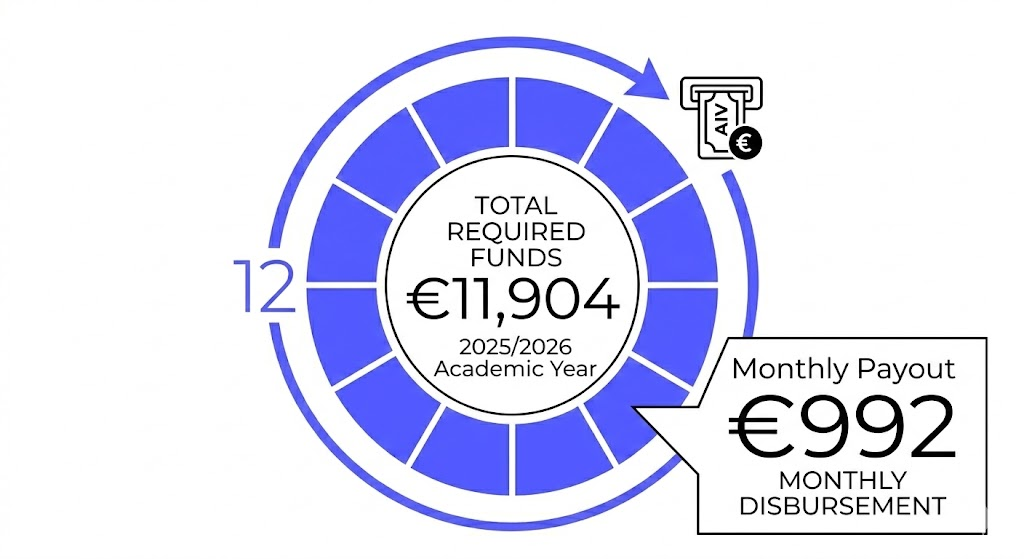
Infographic of the 2025/2026 German Blocked Account requirement
Letter of Commitment (Verpflichtungserklärung)
If you have a relative or a close friend who is a legal resident in Germany, they can "sponsor" your studies.
- How it works: Your sponsor must visit their local Foreigners' Authority (Ausländerbehörde) in Germany and sign a formal document stating they will cover all your living, medical, and return costs.
- The Catch: The sponsor must prove a high, stable income (usually over €2,500–€3,000 net per month depending on their household size) and show that they have enough "disposable" income to support you.
- Best for: Students with immediate family in Germany who want to avoid the high upfront cost of a blocked account.
Scholarship Award Letter
A fully or partially funded scholarship is one of the strongest forms of financial proof.
- The Requirement: The scholarship must cover at least €992 per month. It must be from a recognized provider, such as the DAAD (German Academic Exchange Service), an EU-funded program (Erasmus+), a German political foundation, or the university itself.
- Combining Methods: If your scholarship only gives you €500 per month, you aren't out of luck! You can "top up" the remaining €492 per month by opening a Blocked Account for the difference.
- Best for: High-achieving students and PhD candidates.
III. Academic Verification: APS Certificates & Anabin Degree Recognition
You must provide your entire academic history, but in 2026, the format is just as important as the content.
- The Documents: Original certificates of your High School Diploma (Abitur-equivalent) and any previous University Degrees/Transcripts.
- Legalization & Translation: If your documents are not in German or English, they must be translated by a sworn translator. Many countries also require an Apostille or legalization stamp from the Ministry of Education.
- The APS Certificate: Crucial for students from India, China, and Vietnam. You must first have your documents verified by the Academic Evaluation Centre (APS) before you even apply for the visa. Without an APS certificate, your visa application will be rejected immediately.
- The Anabin Recognition: For some countries (e.g., Pakistan, Nigeria, Morocco, and Mexico), the Consular Services Portal now includes a specific field for "Recognition of School-Leaving Certificate." You must go to the Anabin database (the official German portal for degree equivalence) and find your specific school or university. The portal doesn't just want to see your diploma; it wants to see a PDF printout from Anabin showing your qualifications are recognized in Germany.
If you’re struggling to navigate the Anabin database, just reach out to us, we’ll verify your university’s recognition and provide the exact document you need for your application.
IV. The Two-Step Health Insurance Strategy
Health insurance is mandatory, but most students don't realize they actually need two different types:
- Step 1: Travel Insurance: This covers you for the first 90 days from the moment you land until your university semester officially begins. It must have a minimum coverage of €30,000. Most blocked account providers offer packages including complementary travel health insurance.
- Step 2: Student Health Insurance: Once enrolled, you must switch to a German provider. If you are under 30, you are typically eligible for Public Health Insurance (e.g., TK, AOK, Barmer), which costs approximately €125–€130 per month. If you are over 30 or in a preparatory course, you usually need Private Health Insurance.
We have a comprehensive comparison of all major public and private providers on the "Service Hub" within the VisaFlow platform to help you choose the best fit for your budget.
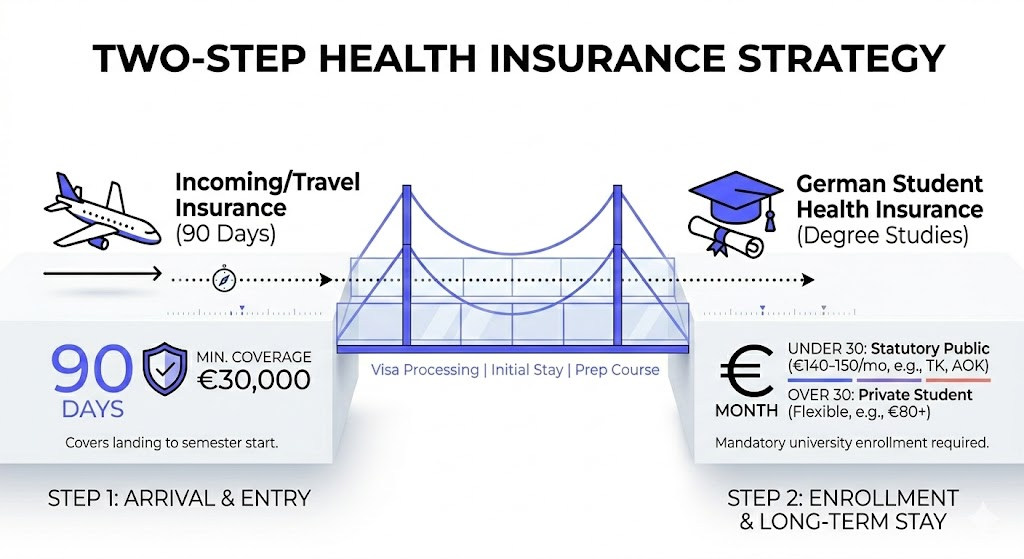
Two-Step Health Insurance Strategy
V. Writing a Winning Motivation Letter (SOP) & CV for German Visas
This is your only chance to "speak" to the visa officer. A weak, AI-generated, or copied letter or CV are a leading cause of rejection. A strong letter and CV must answer:
- Why Germany? Mention specific aspects of the German education system that appeal to you.
- Why this University? Show you've researched the faculty, specific modules, or research facilities.
- What are your career goals? Clearly state how this degree helps your future, and, importantly, mention your intent to return home or how you will contribute to the global workforce.
- Length: Keep it professional and concise; 1 to 2 pages (500–800 words) is the "sweet spot."
Worried your letter sounds too "generic"? Don’t leave your future to chance. At VisaFlow, our experts will personally review your CV and Motivation Letter to ensure they are authentic, logically sound, and optimized for 2026 consulate standards so you can submit your application stress-free.
3. The Different Kinds of Student Visas
"Student Visa" is an umbrella term. Depending on your current academic stage, you will apply for one of these specific sub-types:
I. The Standard Student Visa (Visum zu Studienzwecken)
This is the "normal" visa for the majority of international students. You apply for this if you have already received a formal, official letter of admission (Zulassungsbescheid) from a German university.
- Who it’s for: Students starting a Master’s, Bachelor’s, or PhD program.
- Key Advantage: It is usually valid for the duration of your studies (or issued for 6-12 months and easily extended in Germany). It also allows you to start working part-time (140 full days per year) immediately upon arrival.
- Requirement: An unconditional admission letter (or a conditional one if the only condition is a language placement test).
II. Preparatory Language Course Visa
This is for students who have been admitted to a university on the condition that they reach a specific German language level (usually C1).
- Requirement: The course must be "intensive" (minimum 18 hours per week).
- Note: You cannot work while on a pure language course visa.
III. Preparatory Study College (Studienkolleg) Visa
If your high school diploma is not recognized as equivalent to the German Abitur, you must attend a one-year foundation course known as Studienkolleg.
- Goal: To pass the Feststellungsprüfung (FSP) exam.
- Requirement: An admission letter to a Studienkolleg or a conditional admission to a university that requires the FSP.
IV. Student Applicant Visa (Visum zur Studienbewerbung)
This is for students who haven't received an admission letter yet but need to be in Germany to apply in person or take entrance exams.
- Duration: Valid for up to 9 months.
- Situation: Best if you are waiting for an interview or need to visit various campuses to finalize your choice.
4. Application Procedure for German Student Visa
As of January 2025, the German Federal Foreign Office has streamlined applications through the Consular Services Portal (CSP). However, the procedure depends on whether your local mission has transitioned to this digital system. CSP is yet not available in countries like Iran and Egypt, and only partially available in Nigeria (e.g., not supported at the German embassy in Abuja). On the other hand, students applying from countries like Bangladesh, Ghana, India, Mexico, Morocco, Pakistan, Taiwan, Tunisia, Türkiye, Vietnam can currently use the CSP for their student visa applications.
Scenario 1: CSP Is Available (Digital Application)
If your country is supported by the CSP, the process is significantly faster:
- Online Upload: You fill out the VIDEX form and upload all documents (PDFs) to the portal.
- Digital Pre-Check: Consular officers review your documents online. If anything is missing, you are notified digitally.
- Fast-Track Appointment: Once "pre-approved," you schedule an appointment solely for biometrics (fingerprints) and to show original documents. Processing times are often reduced to 4–6 weeks.
Scenario 2: CSP Is NOT Available (Manual Application)
In regions where the CSP is not yet active, the traditional route applies:
- Manual Booking: You must secure an appointment via the Embassy's booking system (often involving long waitlists).
- Physical Submission: You bring physical paper copies and original documents to the interview.
- Extended Processing: Without the digital pre-check, processing can take 8–12 weeks as documents are physically mailed and verified.
5. Timelines: When Should You Start?
Timing is the most common reason for student visa rejection. We recommend the following schedule:
Phase 1: The Research & Preparation (10–12 Months Before)
Before you even think about a visa, you need to be "eligible."
- 12 Months Before: Start shortlisting programs. Check if your degree is "NC" (Restricted) or "Non-NC" (Open).
- 9 Months Before: Take your language tests (IELTS/TOEFL or TestDaF/Goethe). Results can take weeks, and you need them for your university application.
- Academic Records Verification & Recognition: In 2026, academic verification is a critical prerequisite for your visa. Depending on your country of origin, you will either need an APS Certificate or formal Document Attestation. For students from India, China, and Vietnam, the APS certificate is mandatory and must be obtained before applying for a visa, a process that can take 3–4 months. For many other countries, educational documents must be validated via an Apostille or Legalization from local authorities to be recognized in Germany. Furthermore, when using the Consular Services Portal, some applicants must also provide proof of Anabin recognition, ensuring their university is officially rated as "H+" and their degree is equivalent to German standards.
Phase 2: The University Application (4–6 Months Before)
- Winter Intake (Starts Oct): Portals usually open in May/June; the deadline is typically July 15th.
- Summer Intake (Starts April): Portals open in November/December; the deadline is typically January 15th.
- The VisaFlow Rule: Don't wait for the deadline. Submit your application as soon as the portal opens to get your admission letter earlier. Depending on the university application procedure, the application review might take a longer time.
Phase 3: The Visa Execution (Once Admission is Secured)
Once you have that PDF admission letter in your inbox, the real clock starts ticking.
- Immediately: Open your Blocked Account and finalize your Health Insurance. You cannot book a visa appointment without proof of funds.
- 3–4 Months Before Intake: Submit your application via the Consular Services Portal (CSP) or book your manual appointment.
- 2 Months Before Intake: Most visas are processed within 4–8 weeks. If you haven't submitted by this point, you are in the "Danger Zone."
- 1 Month Before: Receive your visa stamp. Only now should you book your one-way flight to Germany.
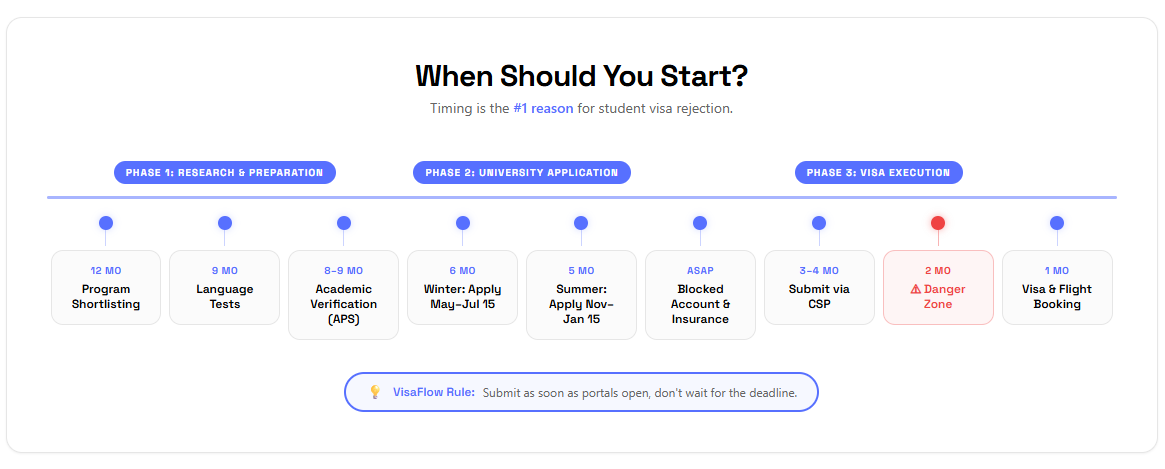
Why VisaFlow?
Navigating the German Student Visa process can be daunting. At VisaFlow, we provide expert guidance to ensure your Motivation Letter is airtight and your financial proofs meet the strict 2026 German standards.
When you join VisaFlow, you aren't just getting a checklist; you’re gaining access to a complete ecosystem designed for your success:
- The Journey Manager: Think of this as your personal mission control. It provides a tailored, step-by-step guide that tracks your progress in real-time. It tells you exactly what to do next, from opening your blocked account to preparing for your specific embassy interview, ensuring you never miss a deadline.
- The Info Hub: Stop scrolling through confusing forums. Our Info Hub is a curated library of expert-verified resources. It has authentic answers for all your possible questions, so you can avoid hours of research and misinformation.
- The Service Hub: This is your one-stop shop for the "Big Five" requirements. Through our Service Hub, you can instantly compare and secure the best Blocked Account providers, and find the right Health Insurance packages. You can also find information on platforms for housing search, network providers and language schools.
- Expert Review & Support: Inside the platform, you can submit your CV and Motivation Letter for professional review. Our experts ensure your "Study Intent" is clearly communicated to satisfy the strict scrutiny of German visa officers.
Ready to start your journey? Let VisaFlow handle the bureaucracy so you can focus on your future in Germany.


Frequently Asked Questions
What is the current Blocked Account amount for 2026?
As of 2026, the required amount for a German Blocked Account (Sperrkonto) is €11,904 per year (or €992 per month). This is a mandatory requirement to prove financial subsistence for your National Visa (Type D) application.
Is the APS Certificate mandatory for my visa application?
The APS Certificate is mandatory only if you obtained your academic qualifications in India, China, or Vietnam. You must secure this certificate before applying through the Consular Services Portal, as it verifies the authenticity of your documents.
What is the difference between "Incoming Insurance" and "Student Health Insurance"?
You need both. Incoming (Travel) Insurance covers your first 90 days in Germany for the visa entry. Once you officially enroll at your university, you must switch to a German Student Health Insurance provider (Public like TK/AOK or Private) to maintain your legal residency.
Can I work in Germany with a Student Visa?
Yes. International students on a standard National Visa can work up to 140 full days or 280 half days per year. Note that students on "Language Course" or "Applicant" visas typically have more restricted working rights.
Is there an age limit for the Germany Student Visa?
There is no official age limit for a student visa. However, if you are over 30, the visa officer will look for a very strong Motivation Letter explaining why you are pursuing this degree now, and you will likely need private rather than public health insurance.
Can I get a Germany Student Visa for a hybrid or online course?
No. In 2026, German consulates have tightened regulations: your admission letter must be for a full-time, on-campus program. Visas for hybrid or distance-learning courses are currently being rejected as they do not meet the "physical presence" requirement for a study permit.
How long does it take to process a German Student Visa in 2026?
With the rollout of the Consular Services Portal (CSP), processing times have been streamlined to approximately 4–8 weeks. However, in high-demand hubs like Mumbai or Lagos, we recommend starting the process 4–5 months before your semester begins to account for appointment wait times.
Do I need an Anabin printout for the Consular Services Portal?
As of February 2026, most countries have discarded the mandatory Anabin printout requirement for the digital portal, as the system now performs internal checks for most regions. Currently, this specific document is primarily required only for applicants from Bangladesh and Taiwan.
What should I do if my university admission is conditional?
You can still apply for a visa with a conditional admission letter (e.g., if you need to pass a final language exam). However, you must prove you meet all other criteria, and your visa may be issued specifically for the preparatory phase of your studies.
How can I avoid a "Lack of Motivation" visa rejection?
To avoid this common rejection, your Statement of Purpose (SOP) must be highly specific. Avoid generic templates; instead, mention specific modules from your curriculum and explain exactly how this degree bridges the gap between your past experience and your future career goals. If you want to ensure your letter meets the highest standards, the experts at VisaFlow can either professionally review your existing draft or help you draft a high-impact Letter of Motivation from scratch to maximize your chances of success. Simply set up your VisaFlow account and let us help you by requesting for documents review inside the platform.